

Last updated: October 6, 2026
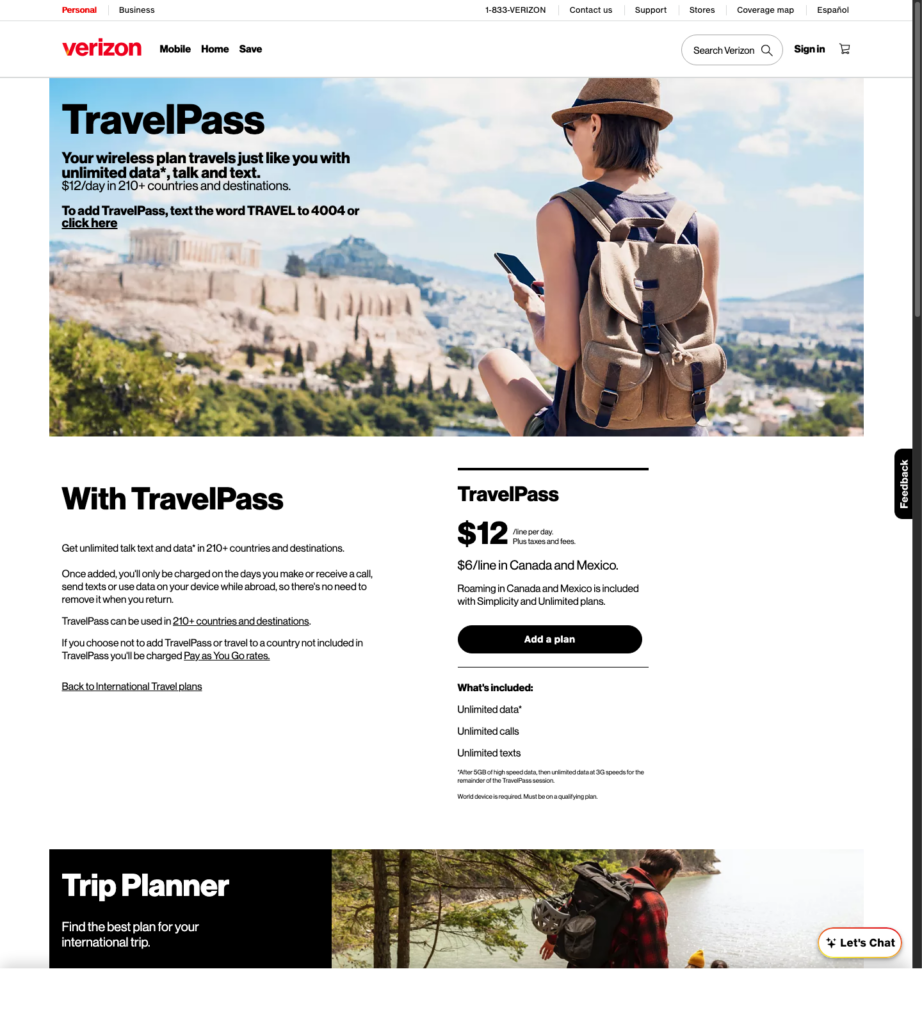
The trap is not that roaming is always bad. The trap is that the first number looks small. Twelve dollars a day sounds harmless when you are standing in an airport. Across a two-week Europe trip, Verizon TravelPass becomes USD 168 if you use it every day. AT&T is more nuanced: its land and air pass is USD 12 per day, but AT&T says it caps land/air charging at 10 daily fees per line, per bill period. That cap helps only if your trip sits inside the right billing window.
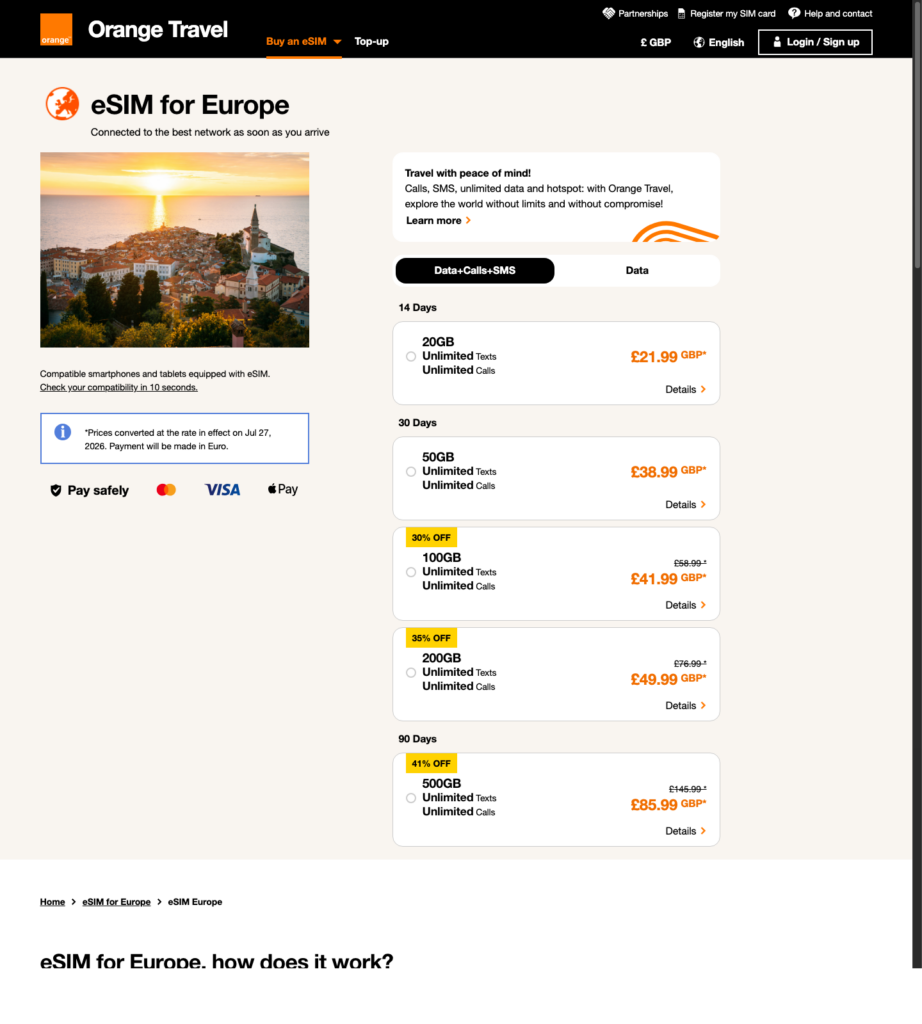
A Europe eSIM changes the shape of the bill. Instead of paying every day your home carrier notices activity, you buy a fixed data bucket before the trip. Orange Travel’s Europe page showed 20 GB for 14 days with calls and SMS at EUR 24.99 in the public source result, while the live browser view from our location rendered the same plan at GBP 21.99 with a note that payment would be made in euros. Airalo’s Europe page rendered localized unlimited packages in euros, with the visible page showing Europe coverage across 41 countries and networks. These are not perfect substitutes for a US carrier pass, but they are enough to make the math uncomfortable.
This guide models the choice for a US traveler taking a 7-day, 14-day, or 21-day Europe trip. Carrier and eSIM pricing was checked against official pages for this update. It does not claim hands-on testing. It is cost math, with the failure modes made explicit.
How We Checked This
We checked official carrier and eSIM pages for Verizon TravelPass, Verizon International Monthly Plan, AT&T International Day Pass support details, T-Mobile International Pass, Airalo Europe eSIM, Orange Travel Europe, Apple eSIM travel support, and Airalo device compatibility. Prices, data buckets, coverage lists, promotions, and carrier terms can change after the checked date. Carrier and eSIM plan prices were checked against the linked official sources before this update. Taxes, carrier fees, exchange-rate swings, cruises, airline roaming, and destination exclusions are not included.
[htb_esim_comparator]
Europe eSIM vs roaming pass: quick answer
Two-week heavy-data comparison
For 14 days of heavy data use, compare the whole trip cost, not the first daily fee: Verizon TravelPass is USD 168 if triggered every day; Verizon’s International Monthly Plan is USD 100 with 20 GB of high-speed data; AT&T International Day Pass can stop at USD 120 for land/air use inside one bill period; T-Mobile’s 30-day International Pass is USD 75 for 30 GB; Orange Travel lists 50 GB for 30 days at EUR 44.99; and Airalo lists a 15-day unlimited Europe package at USD 49. Heavy users should compare the high-speed data bucket and any fair-use limits, not just the word “unlimited.”
For a normal two-week Europe trip, the cheapest defensible answer is usually a Europe eSIM, not a US carrier day pass. If your phone is unlocked and eSIM-compatible, Orange Travel’s 20 GB/14-day Europe plan and Airalo’s localized Europe packages were far below Verizon daily-pass math when checked. AT&T can be closer than it looks because of the 10-fee bill-period cap, but it is still usually more expensive than a Europe eSIM for data-first travelers.
Carrier roaming still wins in three cases. It wins when the trip is one or two days and you value zero setup more than money. It wins when your phone is locked and cannot use a travel eSIM. It can also win when you need your US number to behave normally for calls and SMS all day, not just for app-based messaging.
T-Mobile is the exception among the US carrier examples because some plans already include international high-speed data, and its add-on passes are buckets rather than daily charges. On recheck, T-Mobile listed a 1-day pass at USD 10 for 2 GB, a 10-day pass at USD 50 for 15 GB, and a 30-day pass at USD 75 for 30 GB. The 30-day option now reaches 30 GB, so it can fit moderate-to-heavy use; travelers expecting 40-50 GB or more should still compare larger eSIM buckets.
The cost table
The table below uses one traveler, a land-based Europe trip, and current public prices checked on August 4, 2026. “Light” means maps, messages, tickets, email, searches, and limited social video. “Heavy” means hotspot use, video calls, photo backup, streaming, or a laptop that quietly eats data in the hotel room.
| Trip | Light-use fit | Heavy-use fit | What the math says |
|---|---|---|---|
| 7 days | Orange 20 GB / 14 days: EUR 24.99 public price, or GBP 21.99 in our localized live view | T-Mobile 10-day 15 GB: USD 50; Orange 20 GB / 14 days: EUR 24.99; Airalo 15-day fixed-data or unlimited Europe package | AT&T and Verizon day passes are about USD 84 before taxes. eSIM usually wins unless setup friction matters more. |
| 14 days | Orange 20 GB / 14 days, or Airalo localized Europe package | Orange 50 GB / 30 days: EUR 44.99; T-Mobile 30-day 30 GB: USD 75; Airalo 15-day unlimited Europe: USD 49 | This is where daily-pass math gets ugly. Verizon TravelPass is USD 168 if used every day. AT&T caps land/air use at 10 daily fees per line, per bill period; that can make a contained two-week trip USD 120 before taxes, but a bill-cycle split can cost more. |
| 21 days | Orange 50 GB / 30 days, or Airalo localized Europe package | Orange 50 GB / 30 days; T-Mobile USD 75 for 30 GB; Verizon monthly if 20 GB of high-speed data is enough | Carrier day passes are hard to defend unless you need the home carrier experience. Verizon TravelPass reaches USD 252 if used every day. AT&T may still cap at 10 land/air fees inside one bill period, but a long trip that crosses billing periods needs the bill-cycle check. |
The point is not that Airalo or Orange always wins. It is that a prepaid Europe eSIM turns the phone bill into a fixed decision. Carrier day passes turn it into a daily habit.
Carrier roaming is convenience priced by the day
AT&T International Day Pass is the most easily misunderstood example. AT&T listed land use at USD 12 per day, with additional lines at USD 6 per day on the same calendar day. The pass covers 210+ destinations, and the daily period starts when you first use data, send a text, or make or accept a call. For land-only travel, AT&T says one daily fee covers multiple included destinations inside the same 24-hour period. It also says land and air travel are capped at 10 daily fees per line, per bill period.
That is convenient, and the cap matters. It also means the real question is not just trip length. It is trip length plus billing-cycle timing. A 14-day trip inside one bill period can be very different from a 14-day trip split across two.
Verizon TravelPass is similar daily math. Verizon listed USD 12 per day in 210+ countries and destinations. It also states that each TravelPass session includes 5 GB of high-speed data, then unlimited data at 3G speeds for the rest of that session. That daily 5 GB reset can matter for a heavy user. A traveler uploading video every evening might prefer that to a cheaper monthly bucket.
Verizon also listed a USD 100 International Monthly Plan for trips of 9 days or longer. It includes 20 GB of high-speed data, then 3G speeds, plus unlimited texts and 250 minutes. So a Verizon customer should not blindly multiply USD 12 by 14. If 20 GB is enough, the monthly plan is cheaper. If not, TravelPass gives more daily high-speed breathing room but costs more.
T-Mobile uses a different model. On recheck, the international add-on page listed a 1-day pass at USD 10 for 2 GB, a 10-day pass at USD 50 for 15 GB, and a 30-day pass at USD 75 for 30 GB. It also says one active pass at a time, and that activating a new pass ends the remaining benefits of the prior pass. For a two-week traveler who already has T-Mobile, the 30-day pass can be convenient if 30 GB is enough for the trip.
What an eSIM actually fixes
A travel eSIM fixes three things: price certainty, border friction, and accidental daily activation. Airalo’s Europe page rendered coverage across 41 countries and networks in our live browser check, with localized package pricing. That fits the most common Europe trip: maps, trains, booking apps, WhatsApp, museum tickets, restaurant search, and the occasional video call.
Orange Travel is useful because it shows the other side of the eSIM market. Its Europe page showed 20 GB for 14 days at EUR 24.99 with unlimited texts and calls in the public source result; our live browser view rendered that plan at GBP 21.99 with a note that payment would be made in euros. It also showed 50 GB for 30 days at EUR 44.99 publicly, or GBP 38.99 in our localized browser view. That is not a US carrier roaming pass, and it may not preserve your US number like AT&T or Verizon. But if you want a Europe-focused plan with a much larger data bucket, it is the kind of option that makes daily roaming look expensive.
The catch is device eligibility. Apple says travel eSIM use on iPhone requires an iPhone XS, XS Max, XR, or later, and the phone cannot be locked to a carrier if you want to use another carrier while traveling. Airalo says the same basic thing: the device must support eSIM and must not be carrier or network locked. This is not a footnote. If you financed a phone through a carrier and it is still locked, the cheap eSIM math may be irrelevant.
Worked scenario 1: two weeks, three cities, normal data
Say the trip is Paris, Amsterdam, and Rome over 14 days. You use maps heavily, book trains, message home, check restaurant reviews, save museum tickets, and upload a few photos at night on hotel WiFi. You do not hotspot a laptop.
AT&T International Day Pass is not simply USD 12 times 14 in every case. If the land/air trip sits inside one bill period, AT&T’s 10-fee cap makes the line item USD 120 before taxes and fees. If the trip crosses a bill period, the bill can be higher. Verizon TravelPass is the cleaner daily headline: USD 168 before taxes and fees if used every day, although Verizon customers should compare the USD 100 monthly plan if 20 GB is enough. T-Mobile customers looking only at International Pass can use the USD 75 30-day pass with 30 GB of high-speed data, which is materially stronger than the older 15 GB offer but still a capped bucket.
The eSIM path is much lower for data-first use. Orange Travel’s 20 GB / 14-day Europe option was EUR 24.99 in the public source result, and GBP 21.99 in our localized live browser view. Even after AT&T’s cap, the gap is still meaningful. The real question is whether you are willing to check phone unlock status and install the eSIM before flying.
For this traveler, the answer should usually be yes. Keep the home line active for SMS if needed, turn off data roaming on the home line, and use the travel eSIM as the data line.
Worked scenario 2: three weeks, laptop hotspot, video calls
Now change the trip. London, Paris, Switzerland, Italy, and Germany over 21 days. You use Google Maps constantly, tether a laptop on train days, take work calls, and upload photos. You may burn 30-40 GB without trying very hard.
This is where the cheapest small eSIM is the wrong purchase. Orange Travel’s 50 GB / 30-day option was EUR 44.99 in the public source result, or GBP 38.99 in our localized live browser view. Airalo can also be worth checking for a Europe package, but the page localizes prices and package mixes, so do not buy from memory. T-Mobile’s 30-day International Pass now gives 30 GB for USD 75. That is a much better fit for a 30 GB trip than the older offer, but a 40 GB-plus user can still outgrow the high-speed bucket.
AT&T again depends on the bill period. Inside one bill period, land/air use can stop at 10 daily fees. Across two bill periods, it can keep charging until each period’s cap is reached. Verizon TravelPass is USD 252 if used every day, though it gives 5 GB of high-speed data per daily session. Verizon’s USD 100 monthly plan is cheaper but only gives 20 GB high-speed before 3G speeds, so it may be a bad fit for a hotspot-heavy traveler.
The decision rule changes: for heavy data, buy the plan around the data bucket, not around the trip length. A 21-day trip with 40 GB of real use is not a “three-week roaming” question. It is a 40 GB mobile-data purchase.
When roaming is still the right answer
Roaming is still rational for a one-day stopover, a two-day work trip, or a traveler who values “it just works” more than the price difference. If you are landing in Madrid on Thursday and flying home Saturday morning, paying one or two daily fees may be worth avoiding a setup task.
Roaming can also be right for calls and SMS. A data-only eSIM does not give you your US carrier voice experience. WhatsApp, FaceTime, iMessage, Signal, and email can run over data, but banks, employers, airlines, and family members may still depend on your regular number.
The third case is locked hardware. If the phone is locked, or you cannot confirm eSIM support before departure, do not build the whole trip around a prepaid eSIM. Check the device first. Apple and Airalo both point travelers back to the same requirement: eSIM support and no carrier lock.
What not to do
Do not leave your home line’s data roaming on “just in case” while assuming the travel eSIM is doing all the work. On dual-SIM phones, the wrong default data line can turn a cheap eSIM decision into a carrier bill. Label the travel eSIM clearly, set it as the cellular data line, and disable data roaming on the home line unless you intentionally want the carrier pass.
Do not buy the smallest eSIM plan because the price looks good. A 3 GB plan can work for a careful traveler using hotel WiFi. It is not enough for TikTok, Instagram video, photo backup, hotspot, or remote work.
Do not compare a data-only eSIM to a carrier roaming pass as if they include the same thing. Carrier passes generally preserve your domestic plan behavior for calls and texts abroad. Many travel eSIMs are data-only. That difference matters for some travelers and not at all for others.
The decision rule
Use carrier roaming if the trip is under 48 hours, your phone is locked, your home number must behave normally, or you already have a T-Mobile plan whose included international data or USD 75 30-day pass is enough for your actual usage.
Use a Europe eSIM if the trip is a week or longer, your phone is unlocked, and most communication can happen through data apps. For a normal two-week trip, start by checking a 10 GB to 20 GB Europe plan. For a three-week or hotspot-heavy trip, start at 30 GB to 50 GB instead of pretending you are a light user.
Use a local/European carrier travel option like Orange Travel when you want an eSIM with a bigger Europe data bucket and calls/SMS included, and you do not need your US carrier plan to behave exactly as it does at home.
This is the same kind of math as a broader trip budget: the headline price is less important than the moment the rule starts charging you. Roaming charges by the active day. eSIMs charge by the bucket. Pick the model that matches how you actually travel, not the one that sounds easiest while you are still at the gate.
For more Europe trip cost decisions, see the car vs train cost math. If this trip is part of a larger Asia itinerary, the same “checked price, real use, failure mode” method is used in the Japan budget planner.
For the rest of the hidden travel budget, also add city tourist taxes.
Sources
- Verizon TravelPass.
- Verizon International Monthly Plan.
- AT&T International Day Pass support details.
- T-Mobile International Pass.
- Airalo Europe eSIM.
- Orange Travel Europe eSIM.
- Apple Support: use eSIM while traveling internationally – checked August 4, 2026.
- Airalo device compatibility – checked August 4, 2026.