Categories
Travel

Renting a Car in Europe vs Taking Trains: Cost Math for 2026

Last updated: June 17, 2026

The advertised daily rental rate is a lie of omission. Not a lie exactly — just half the story.

A €25/day rate becomes €38 by the time you add fuel. Throw in tolls, parking, the cross-border fee, and the cover upgrade you actually need rather than the basic one that leaves you exposed for €1,500, and you’re at €60-70/day on a normal day. That’s before anyone hits a ZTL camera in Florence.

This article works through the math both ways for three real European routes. Sometimes the car wins. Sometimes the train wins. Sometimes neither wins on their own — the right answer is a split plan, and most travelers never consider it.

Pricing checked the week of June 13, 2026. Fuel prices come from the European Commission’s Weekly Oil Bulletin (June 11, 2026 release). Verify any number on the day you book.

Quick answer

Take the train when one or two people are moving between major cities and the dates are firm enough to lock advance fares 30 to 60 days out. The math almost never works for the car in this scenario, and the car comes with a parking problem you don’t want.

Rent a car when three or four people are sharing a rural loop with multiple stops and you know where the car sleeps each night. The per-person cost drops, and the train math collapses the moment you need a taxi to reach a hill town.

Use a split plan when the trip is two cities and three rural days. Train the long city legs, rent locally for the rural segment. This removes the worst penalty in European car rental — the international one-way drop fee — and usually beats both pure plans on total cost.

The headline rate is not the rental’s cost. The rental’s cost is the rate plus cover, plus fuel, plus tolls, plus vignettes, plus parking, plus drop fees, plus any city-center fines you collect along the way.

The decision in one table

Itinerary Default Why it wins Watch for
1-2 people, major cities only Train Advance fares, central stations, zero parking Cheap fares are usually non-refundable
3-4 people, rural loop Car Vehicle cost is shared; rural transfers disappear Cover, fuel, tolls, parking, and drop fees add real money
Multi-country open-jaw Train or split International one-way drop fees can dominate Cross-border permission is not foreign-return permission
Two cities + 2-3 rural days Split plan Train for the long leg, rent for the rural segment Two bookings, usually lower total
Driver under 25 Train, more often than not Young-driver surcharge can erase the car advantage Rules vary by supplier and country
Historic-center hotel stay Train Unused car costs money every day; ZTL is a real risk Hotel parking may be outside the restricted zone
Bulky luggage or limited mobility Car can win Door-to-door movement is worth real money Confirm vehicle size and accessible parking

The fully loaded comparison

There are exactly two rules.

Car total = rental quote + cover upgrade + fuel + tolls/vignettes + parking + cross-border/one-way fees + any local transport you still need.

Rail total = point-to-point fares or a pass + mandatory reservations + station transfers + the rural bus or taxi that fills the gap rail doesn’t cover.

Then divide. Car cost per traveler = car total ÷ number of travelers. Rail cost per traveler = rail total ÷ number of travelers.

The break-even isn’t a clean number. As editorial decision rules — not market averages, not statutory thresholds — here’s how to read the result:

  • If the car saves less than €15 per traveler per day, take the train anyway. Parking stress, pickup time, and city restrictions are worth more than €15/day to most people
  • If the car saves €25/day or more per traveler and the route includes two or more rural stops that public transport handles badly, the car wins
  • Between the two, compare access (does the car actually reach the place you want to go?) and flexibility (can you change plans mid-trip?) rather than letting a small price difference decide

For the rail half of the calculation, our Eurail Pass Calculator breaks down when the pass beats point-to-point tickets and when it doesn’t. The same break-even discipline applies.

What a European rental actually costs

The headline rate hides three categories of cost that show up at the register.

Rental price and taxes

The rate you see in the search aggregator is usually the base before taxes, airport surcharges, and location fees. Auto Europe is upfront about this — their displayed rates assume a seven-day rental, and they warn that taxes and extra surcharges may apply. Their booking form also flags age surcharges outside the standard 30-65 driver range.

The same compact car at the same airport on the same dates can have a 15-25% spread between the cheapest aggregator hit and what you actually pay at the counter. Always book the like-for-like total, not the teaser.

For reproducible quotes, fix these variables across every supplier you check: driver age, country of residence, exact pickup time, exact return time, vehicle class, mileage policy, fuel policy, included cover, excess amount, cross-border fee, one-way fee, cancellation terms, all taxes included. Save a PDF of the chosen quote. You’re building a paper trail.

Cover and excess

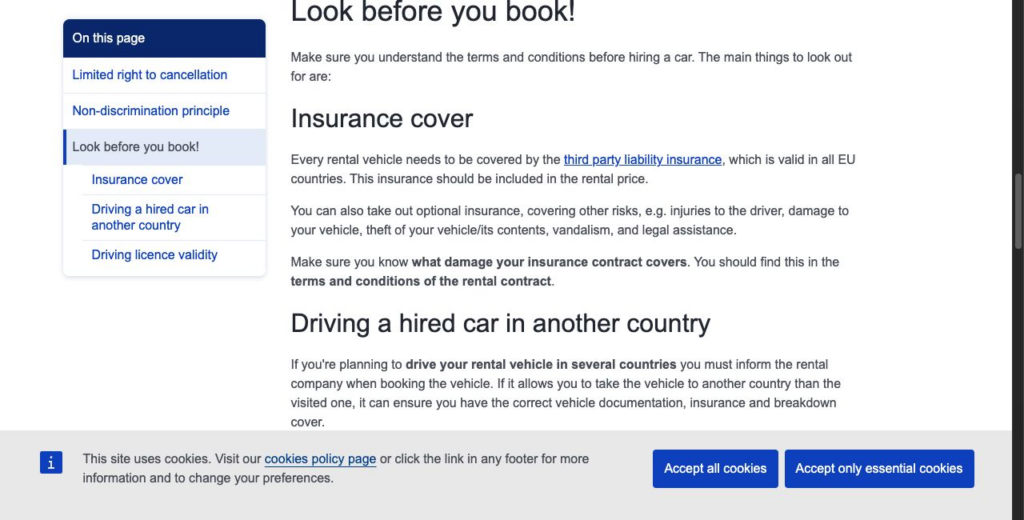
The basic cover that comes with the rental almost always leaves you exposed for a deductible — the “excess” — of €1,000-2,000. Some are higher. If you damage the car, you pay that amount before any insurance kicks in.

The excess-reduction product the supplier sells at the counter costs €8-20/day. Third-party policies (Insurance4CarHire, RentalCover) are usually cheaper but require you to front the damage and claim it back. Some credit cards include rental cover; check the actual policy terms before relying on it.

The choice isn’t whether to buy cover. It’s which version of cover to buy. Skip this step and one bad door scratch costs you a thousand euros.

Fuel

Use the European Commission’s Weekly Oil Bulletin for the country price of Euro Super 95. The June 11, 2026 release is what we used.

Assume 6.0 L/100 km for a compact petrol car. Real consumption varies — a small diesel might do 4.5, a loaded SUV in mountains might do 8. Show the math at 5.0 and 7.0 as well, so the reader sees the spread.

Fuel cost = route kilometers × 0.06 × fuel price per liter. A 1,000 km Tuscan loop at €1.78/liter (Italian price as of June 11, 2026) lands at €107 at 6.0 L/100 km. €89 if you’re efficient. €125 if you’re not.

Tolls and vignettes

Italy, France, Spain, Portugal, and Croatia use distance-based tolls on motorways. Use the official operator’s route calculator for the exact segments — Autostrade per l’Italia for Italy, PT Tolls for Portugal, HAC for Croatia. Generic “Italian toll per km” estimates are wrong often enough that they’re not worth using.

Austria, Switzerland, Slovenia, Czech Republic, Slovakia, Hungary, and Romania use vignettes — time-based motorway permits. Prices vary, validity rules vary, digital purchase delays vary. The compact summary:

Country What you need 2026 reality
Austria ASFINAG vignette + separate section tolls €9.60 one day, €12.80 ten days, €32 two months, €106.80 annual. Digital one-day and ten-day products are valid immediately; two-month and annual digital vignettes have an 18-day delay for consumer purchases
Switzerland Federal motorway vignette CHF 40 for the year. Both the physical sticker and the digital version cost the same. There is no short-stay option. A two-day motorway user still pays CHF 40 unless the rental already carries one
Slovenia DARS e-vignette + separate Karavanke tunnel Plate-linked. Karavanke tunnel toll is €9 separately. H5 and H6 coastal expressway sections became vignette-free on January 1, 2026
Czech Republic eDalnice e-vignette Buy on the official site only
Slovakia eznamka e-vignette Buy on the official site only
Hungary National e-vignette Verify category and validity before buying; don’t use resellers
Romania CNAIR rovinieta Use the official portal

Before adding a vignette to your math, check the windscreen, the rental agreement, and the supplier’s terms. A locally registered rental often already carries the domestic vignette.

Parking and restricted zones

The Italian ZTL is the most expensive mistake European tourists make. Historic centers in Florence, Rome, Milan, and dozens of other Italian cities use camera-enforced restricted zones. Drive into one without authorization and you collect a €60-100 fine, plus a rental-company admin fee, often arriving in the mail six months after you’ve forgotten the trip.

Two rules that prevent the problem:

  1. Book accommodation that confirms legal vehicle access. Don’t trust the listing — confirm by email with the hotel
  2. If access isn’t confirmed, park outside the restricted zone and walk in

Rome’s ZTL rules also shift during the year. Electric and hydrogen vehicle access rules change July 1, 2026. The lesson isn’t to memorize the rules — it’s to check the municipal site within a week of your arrival because the rules you read three months ago may not be the rules in force now.

For parking, calculate two scenarios per night: accommodation includes parking at no extra cost, or paid city parking at the official daily tariff. Most trips fall somewhere between. Picking only the cheaper assumption usually underestimates your bill by €15-30/night.

What rail comparisons forget

Rail isn’t free of hidden costs either, and pretending otherwise is what makes the “trains are always cheaper” people miss the trip-killer details.

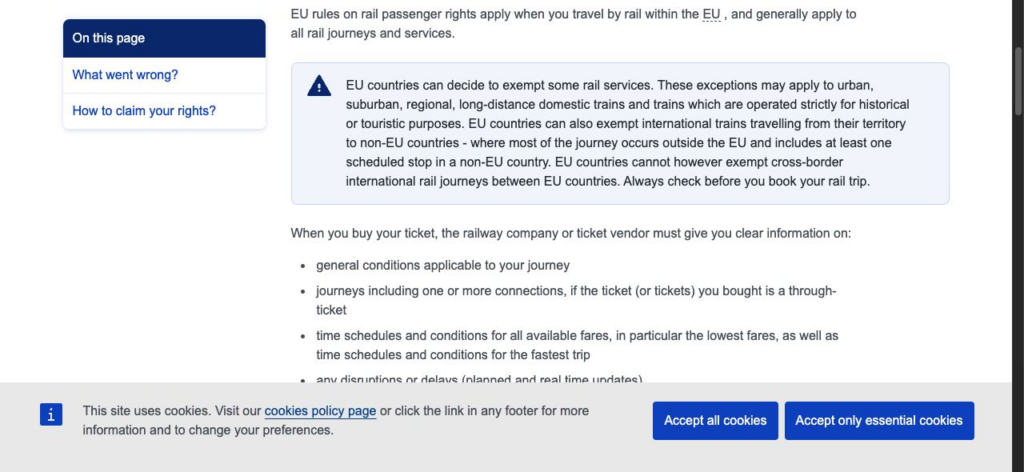
Reservation fees on French TGV, Italian Frecciarossa, Spanish AVE, and Eurostar are mandatory and not included in a Eurail Pass. They run €10-30 each. A four-segment trip can add €60-100 you didn’t price.

Local transfers at both ends. Train to Pisa, sure. Now you need to reach Volterra, which is a 90-minute bus ride that runs three times a day and doesn’t operate on Sundays. That’s not a hypothetical, that’s Tuscany.

Rural buses, taxis, and last-mile gaps. The train brings you to the regional station. From there, you’re on whatever local transit exists, which in rural Europe can range from “excellent and frequent” to “your hotel sends someone to pick you up because there is no bus.”

Cheap advance fares are usually fixed. Refundable? No. Changeable? Often not, or only with a fee. If your plans shift, the cheap rail price evaporates.

The pass math is separate. A Eurail Pass and a stack of point-to-point tickets are not interchangeable — the Eurail Pass Calculator goes deep on when the pass actually wins.

Group-size break-even

Number of travelers is the biggest single variable in the car vs train math.

Group size Car economics Train economics Default lean
1 Full cost on one person One fare Train, almost always
2 Cost split in half Two fares Depends on rural exposure
3 Cost split in three Three fares Car often wins on rural routes
4 Cost split in four Four fares Car wins decisively on rural routes
5+ One car may not fit; second car negates the savings Five+ fares Depends on whether one big car fits everyone

The simplest version: every additional person makes the car cheaper per head while making zero difference to the rail cost per head. The break-even sits somewhere between 2 and 3 travelers on most routes. Below that, train. Above that, car.

Worked example 1: rural Tuscany loop

Route: Pisa Airport → Volterra → Siena → Montepulciano → Florence Airport. Five rental days. Compact manual. Driver age 35. Pickup Pisa Airport, return Florence Airport (same-country one-way).

This is the example where the car is supposed to win, and probably does — but we have to do the math to find out.

Fuel model

Italian Euro Super 95 was €1.78/liter on June 11, 2026 (Weekly Oil Bulletin). The route is roughly 600 km.

Consumption Math Total
5.0 L/100 km 600 × 0.05 × €1.78 €53.40
6.0 L/100 km 600 × 0.06 × €1.78 €64.08
7.0 L/100 km 600 × 0.07 × €1.78 €74.76

Break-even test

For four travelers, the car wins easily. The rental, cover, fuel, tolls, and parking divided four ways come in well under what four advance regional rail tickets plus the bus to Volterra plus the taxi to Montepulciano’s center would cost.

For two travelers, it’s closer. The per-head split is half, but the rural bus and taxi costs the train requires don’t reduce by group size — those are per-person tickets too. The car often still wins, but by less than you’d expect.

For one traveler, the math collapses. The full car cost on one person rarely beats the train-and-bus option for a solo trip, even when the rail itinerary involves transfers most travelers would rather avoid.

The honest reading: this route was selected because hill towns have weak direct rail. That’s the point of the example. It doesn’t prove a car beats trains in Italy generally — it shows a kind of itinerary where the car wins. Pisa → Florence → Rome looks completely different.

Worked example 2: Lisbon, Algarve, Seville, Granada, Madrid

Route: five cities, two countries, ten days. Three plans worth comparing.

Plan A: one continuous international one-way rental

Pick up in Lisbon, drop in Madrid. Includes the international one-way drop fee, which can range widely by supplier and vehicle class. We’re not putting a number on it — fees vary too much to fake precision — but it’s the largest single variable in this plan.

Only worth running if you can get an actual bookable quote that keeps the drop fee under control. Don’t substitute a domestic one-way as a placeholder.

Plan B: the split plan

This is usually the answer.

  1. Rail or coach Lisbon to an Algarve base (CP InterCity, or direct via local connection)
  2. Short Portuguese rental for the Algarve, returned in Portugal — no international drop fee
  3. Alsa coach Lisbon-Seville handles the cross-border leg, or you connect via Faro
  4. Renfe for Seville to Granada to Madrid

Plan B removes the international one-way fee and uses each transport mode where it works best. The Algarve rental gives you rural mobility for the few days it matters. Rail handles the long city-to-city segments.

Plan C: rail and coach only

CP for Lisbon-Algarve, Alsa or Renfe combinations for the cross-border leg, Renfe AVE for the Spanish leg. Cheapest by far. Less flexible. Cuts you off from any village or beach the bus doesn’t reach.

Fuel model

Iberian Plan A involves roughly 1,800 km of driving. Portuguese petrol was €1.71/liter, Spanish €1.55/liter on June 11, 2026.

Consumption Math Total
5.0 L/100 km 1,800 × 0.05 × €1.62 avg €145.80
6.0 L/100 km 1,800 × 0.06 × €1.62 avg €174.96
7.0 L/100 km 1,800 × 0.07 × €1.62 avg €204.12

The honest verdict: for most groups, Plan B beats Plan A on price and Plan C on flexibility. The Iberian Peninsula is one of the cleanest cases in Europe for the split-plan approach.

Worked example 3: Croatian road circuit

Route: Zagreb → Plitvice Lakes → Split → Dubrovnik. Seven rental days. Compact manual. Driver age 35. Domestic one-way Zagreb to Dubrovnik.

Two things to know before doing the math.

First, since the Peljesac Bridge opened in July 2022, the road from Split to Dubrovnik stays inside Croatia start to finish. The old Neum corridor through Bosnia and Herzegovina — which used to interrupt EU territory for about 10 km and required either two extra border crossings or a ferry — is now bypassed entirely. Old travel guides still mention the ferry or the Bosnia detour. Ignore them. The route is continuous.

Second, Croatian rail does not cover this itinerary. So the real comparison is car versus bus, not car versus train.

Fuel model

Croatian petrol was €1.65/liter on June 11, 2026. The route is roughly 700 km.

Consumption Math Total
5.0 L/100 km 700 × 0.05 × €1.65 €57.75
6.0 L/100 km 700 × 0.06 × €1.65 €69.30
7.0 L/100 km 700 × 0.07 × €1.65 €80.85

Add HAC motorway tolls, cover upgrade, parking at Plitvice, parking in Split, parking in Dubrovnik, and the domestic one-way drop charge.

The verdict: the car usually wins for three or four travelers, especially with rural side trips. For one traveler, the bus chain (Zagreb-Plitvice, Plitvice-Split, Split-Dubrovnik) is often cheaper and not much slower in peak season — when motorway traffic into Dubrovnik can wipe out the car’s time advantage anyway.

One detail that flips the math: if the only reason to keep the car after Split is to reach Dubrovnik, return it on arrival in Dubrovnik. Otherwise you’re paying for parking and drop fees on a vehicle that sits unused while you spend three days inside the city walls.

When a car wins

Three or four people sharing one vehicle. At least two rural stops where rural buses are slow, infrequent, or non-existent. Same-country return with no big international one-way fee. Accommodation that includes parking, or accommodation in towns where parking is cheap. The car moves most days, not most of one day and zero on the others. Driver’s age avoids the young-driver surcharge (typically under 25) and the senior surcharge (typically over 75). Luggage, child seats, or mobility needs that make repeated transfers expensive or impossible.

When trains win

One or two travelers. City-center to city-center itinerary. Dates locked enough to buy advance fares 30-60 days ahead. High parking costs at the destination, or ZTL exposure that makes city driving hostile. International one-way that would carry a heavy drop fee. The traveler does not want to drive in a foreign country, or specifically does not want to drive manual transmission. Trip includes long city stays where the car would sit unused. High-speed rail covers the longest segment efficiently.

When a split plan wins

The itinerary is city-city-rural-city. Rural access is needed for two to four days, not the whole trip. The international one-way drop fee would exceed the cost of returning the first rental and crossing the border by public transport. The train covers the longest segment efficiently but local transit at the destination is weak. The final city has expensive parking.

Vignettes, tolls, and city traps

The full vignette table is above. The big ones to remember:

Switzerland sells no short-stay vignette. CHF 40 for the year, full stop. A two-day motorway crossing still costs you CHF 40 unless the rental already carries one. Avoiding motorways through Switzerland adds 1-2 hours to most routes.

Austria has a one-day digital product valid immediately for €9.60. That’s the cheapest legal option for a single-day crossing.

Italy’s tolls are distance-based, not flat. Use Autostrade per l’Italia’s route calculator for the specific segments you’ll drive. Italian ZTL fines are the most expensive mistake on this list — confirm legal hotel access before arrival, not after.

Croatia’s HAC publishes current toll tables by motorway section and vehicle class. The Peljesac Bridge makes the southern Dalmatia route continuous.

Portugal’s electronic-only toll roads require a payment method set up before driving on them. Rental cars usually include a transponder; confirm with your supplier and check the administration fee.

Cross-border and one-way rental rules

Driving abroad and returning abroad are two different contract terms. A rental that permits driving into France from Germany does not automatically permit returning the car in France.

Before booking, save the supplier terms showing:

  • Permitted and excluded countries
  • The cross-border fee, if any
  • The international return fee
  • Where roadside assistance covers
  • Ferry restrictions, if you’re considering an island detour
  • Required documents (some countries want written cross-border authorization)
  • Deposit amount and excess

If the international one-way drop fee looks heavy, test the split rental approach. Often the math wins by enough margin that it’s not even close.

Common mistakes

Mistake Why it costs you Better rule
Comparing the teaser rental rate with a full rail fare The rental headline omits 30-50% of what you’ll actually pay Compare final checkout totals for the same dates and group size
Skipping the excess-reduction product One door scratch costs you the excess, often €1,000-2,000 Price the cover before booking, not at the counter
Treating cross-border permission as foreign-return permission Different contract terms, often different prices Confirm both in writing before paying
Booking an automatic without comparing the manual rate Automatics are scarcer and pricier in Europe Compare both for the same dates
Driving to an Italian historic-center hotel without checking ZTL The camera issues the fine automatically and the bill arrives months later Confirm legal access and parking by email before arrival
Buying a vignette already included with the car Wasted money on something the rental already carries Check the windscreen, plate, and agreement first
Keeping the car through a multi-day city stay Parking fees compound while the car adds zero value Return the car before the city portion of the trip
Dividing rail cost by group size Rail is sold per person, not per vehicle Divide only the car costs by group size
Calling a rural-with-bus-gaps chain a “train itinerary” The bus or taxi changes both cost and time Price every segment to the actual destination

What this comparison does not cover

  • Motorhomes and campervans (different cost model, different ruleset)
  • Electric vehicle charging economics (worth its own article)
  • Winter equipment fees, snow chain rules, and Alpine-specific surcharges
  • Drivers under 21 or above the supplier’s age limit (usually 75 or 80)
  • Accessibility requirements that need an adapted vehicle
  • Damage disputes, credit-card cover specifics, and country-specific legal advice
  • Every European toll, low-emission zone, and city restriction (just the major ones above)
  • Carbon emissions comparison

This article assumes a compact petrol car, a driver aged 35, leisure travel. A young-driver fee, an automatic-only requirement, or an adapted vehicle changes the math before fuel enters the picture.

FAQ

Is renting a car cheaper than trains in Europe for two people?

Sometimes. For city-to-city trips, almost never. For rural routes where the train doesn’t reach the actual destination, often yes — but only after you add the bus or taxi cost on the train side. Run both totals fully loaded before deciding.

At what group size does a rental car usually become cheaper?

Three travelers tips it in most cases. Four travelers tips it decisively, especially on rural loops. Two travelers is the genuine border case where the route matters more than the math.

Can a rental car cross European borders?

Most can, with permission. Some can’t. Confirm permitted countries and the cross-border fee before booking. Permission to drive into a country is not permission to return the car there — those are separate.

Why are international one-way rentals expensive?

Cars don’t naturally redistribute. A car dropped in Madrid by a one-way renter has to get back to Lisbon somehow, usually by being driven empty or shipped. The supplier passes that cost on as the drop fee. Some routes get heavily subsidized — others get punished.

Do I need an International Driving Permit?

It depends on your license, the country you’re driving in, the length of your stay, and the rental supplier. The U.S. State Department directs U.S. travelers to AAA or AATA in countries where an IDP is required. UK photocard holders generally don’t need one for the EU, Switzerland, Norway, Iceland, or Liechtenstein. Carry the original license — the IDP doesn’t replace it. Confirm requirements country by country before traveling.

Does a European rental include motorway vignettes?

Often, for the country it’s registered in. Sometimes not. A car rented in Austria usually carries the Austrian vignette. The same car driven into Slovenia does not automatically carry the Slovenian one. Check the windscreen, plate registration, and rental agreement before buying anything separately.

Is an automatic rental much more expensive than a manual?

In Europe, usually yes. Manual is the default; automatic supply is smaller and priced accordingly. The premium ranges from 20% to 80% depending on the country and the season. For an Italian summer rental, automatics can be hard to find at any price during peak weeks.

Is Eurail cheaper than renting a car?

Depends on the route. A Eurail Pass is a flexibility premium — you pay more than the cheapest advance tickets, in exchange for the ability to ride almost any train on whatever day you want. Run the Eurail Pass Calculator math against the car total. Sometimes the pass wins. Sometimes point-to-point tickets win. Sometimes the car wins. There’s no universal answer.

Should I keep the rental car during a multi-day city visit?

Usually no. Parking costs compound, the car sits unused, and ZTL exposure ticks up every day. Return the car when you reach the city, take public transport during your stay, and pick up another rental (or use the train) when you leave. The math almost always works out better.

Sources

Changelog

  • 2026-06-16 — Article rewritten end-to-end with new editorial voice. Pricing and fuel data verified June 13, 2026
  • 2026-06-14 — Original publication
Leave a Reply