
Last updated: October 6, 2026
Stripe looks cheaper until the first tax question arrives from a customer in another country.
How we checked this
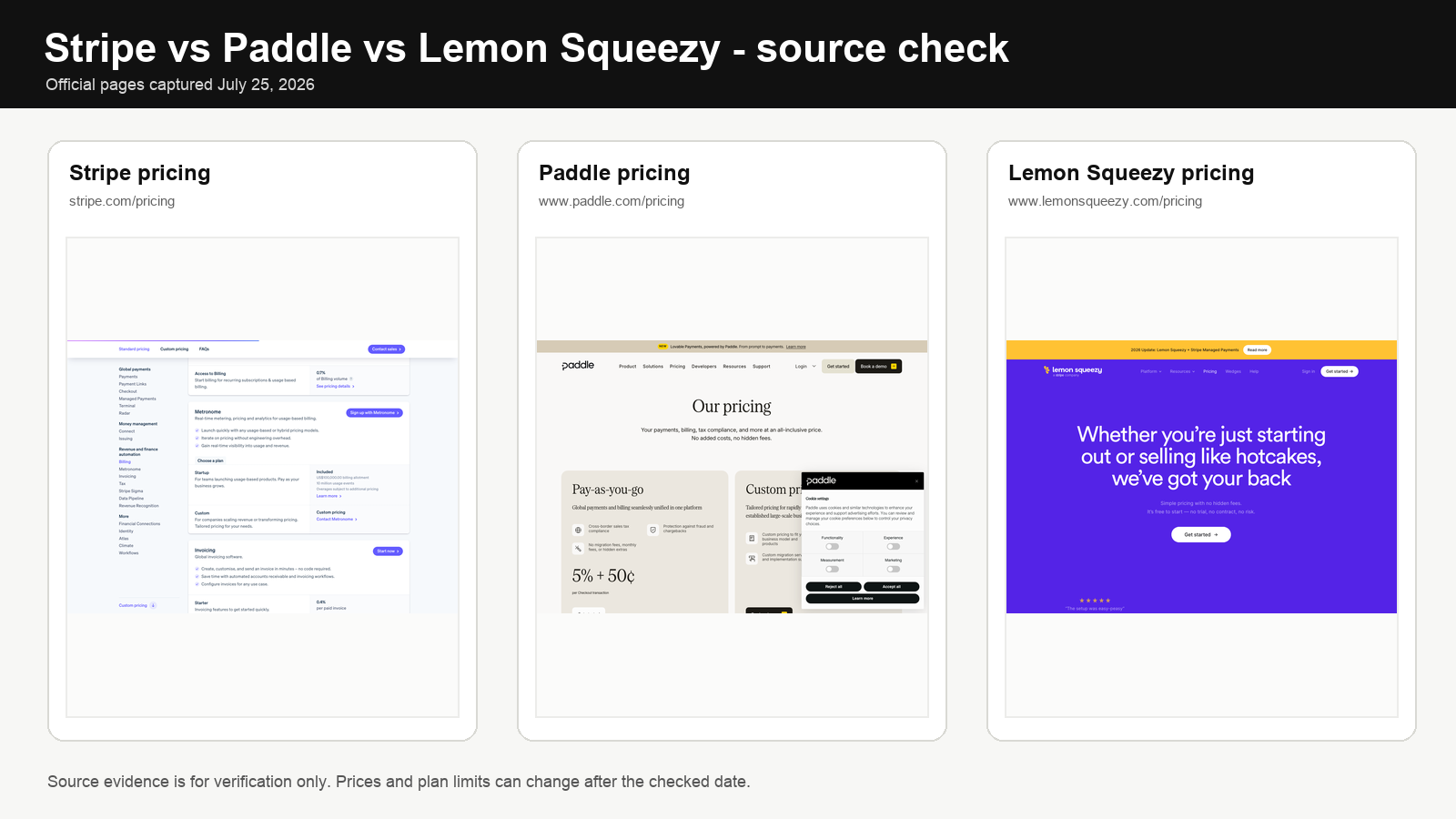
We checked the official pricing and source pages shown in the featured image: Stripe pricing, Paddle pricing, Lemon Squeezy pricing. We used public product pages and help pages, not affiliate roundups. Prices, plan names, and limits can change after the checked date.
That is the honest starting point for this comparison. Stripe, Paddle, and Lemon Squeezy are not three versions of the same thing. Stripe direct is usually a payment, billing, and tax-tooling stack where your company remains the seller. Paddle and Lemon Squeezy are Merchant of Record platforms, which means the platform is the legal seller for supported transactions, collects payment, handles a large part of sales tax or VAT work, and pays you the net amount after fees and adjustments.
The practical question is not which logo has the lowest headline fee. The question is whether the Merchant of Record premium is cheaper than the compliance, support, billing, refund, dispute, and tax work you would otherwise own yourself.
Sources and prices in this guide were checked against the linked official pages. Pricing changes often, and Stripe pricing is localized by country, so use the examples as a model and replace the assumptions with the prices shown in your own account.
Quick Answer
Choose Stripe direct when you mostly sell B2B, need control over invoices and contracts, already have tax or finance support, or want the most flexible billing stack. It is usually the strongest default for sales-led SaaS, procurement-heavy buyers, and teams that want direct control over checkout, customer data, invoices, and payment methods.
Choose Paddle when you sell SaaS or app subscriptions globally and want one platform to absorb much of the tax, compliance, billing, fraud, dispute, and billing-support burden. It is often strongest for self-serve software sold across countries.
Choose Lemon Squeezy when you want a fast hosted setup for digital products, software, templates, courses, or simpler SaaS subscriptions. It is attractive for founder-led products that need speed more than custom finance plumbing, but SaaS sellers need to model its subscription, international, PayPal, and payout fee details.
At $10K MRR, a Merchant of Record can pay for itself if it saves only a few hours of founder time each month. At $100K MRR, the public MoR premium becomes large enough that custom pricing and internal finance help deserve a real comparison.
EU VAT: Stripe Tax vs Paddle vs Lemon Squeezy
If EU VAT compliance is the reason you are comparing these platforms, the key distinction is not the tax calculator. It is who remains the seller. With Stripe direct plus Stripe Tax, your business remains the Merchant of Record and keeps the tax liability. Stripe Tax can calculate and collect tax and support tax workflows, but it does not by itself transfer seller responsibility to Stripe.
Paddle and Lemon Squeezy act as Merchant of Record for supported sales, so they take on the seller role and the associated VAT or sales-tax collection and remittance obligations covered by their services. Stripe Managed Payments is Stripe’s own Merchant of Record option; its current public price is 3.5% per successful Managed Payments transaction on top of standard Payments fees.
| Setup | Who is the Merchant of Record? | EU VAT / tax responsibility |
|---|---|---|
| Stripe direct + Stripe Tax | Your business | You keep the tax liability; Stripe provides tax tooling. |
| Paddle | Paddle for supported transactions | Paddle’s MoR service includes global tax and regulatory compliance. |
| Lemon Squeezy | Lemon Squeezy for supported transactions | Lemon Squeezy says it calculates, collects, files, and pays applicable sales tax/VAT as MoR. |
| Stripe Managed Payments | Stripe / its MoR entity for supported transactions | MoR service includes indirect-tax compliance and remittance; 3.5% is added to Payments fees. |
| Business profile | Best default | Why | Watch out for |
|---|---|---|---|
| Solo founder selling global B2C SaaS | Paddle or Lemon Squeezy | Tax, refunds, failed payments, and support can eat founder time fast. | Low average prices make the fixed 50-cent fee painful. |
| B2B SaaS with invoices and custom terms | Stripe direct | You keep more control over contracts, collections, procurement, and finance workflows. | You still own registrations, filings, and tax process where required. |
| $10K MRR self-serve product | Often MoR | The premium can be less than a few hours of monthly admin time. | Confirm payout timing, product eligibility, and statement descriptor behavior. |
| $50K MRR mixed B2C and B2B | Model both | Either answer can be right depending on customer countries and support load. | Do not mistake tax calculation for full compliance. |
| $100K MRR global B2C product | Stripe direct or negotiated MoR | The offload may still be worth it, but public fees are now material. | Ask for custom pricing before accepting the public math. |
| Existing Stripe product expanding internationally | Stripe direct plus Tax, or Stripe Managed Payments where available | You may keep more of the Stripe stack while adding compliance coverage. | Managed Payments adds MoR fees on top of Payments fees. |
| Digital downloads plus simple subscriptions | Lemon Squeezy | Hosted checkout and MoR coverage can be faster than building a stack. | Subscription, international, PayPal, and payout fees can change the real cost. |
What A Merchant Of Record Actually Changes
A Merchant of Record is the legal seller for the transaction. In a direct Stripe setup, your company sells to the customer and Stripe processes the payment. With a MoR, the MoR sells to the customer, takes responsibility for many payment and post-sale obligations, then remits your payout after platform fees, taxes, refunds, chargebacks, and other adjustments.
That sounds abstract until the first operational question appears. Who calculated VAT? Who registered in the relevant country? Who sends the receipt? Who handles a chargeback? Who answers a billing-support question? Who keeps records if a tax authority asks? Who appears on the card statement? Who pays you, when, and in which currency?
Those are not small details. They are the reason a MoR can be worth paying for even when the card-processing fee looks higher.
The tradeoff is control. Some enterprise customers need to contract with your legal entity. Some product categories may not fit MoR terms. You may also have less flexibility around invoices, refunds, checkout customization, data portability, payment methods, or migration.
Pricing Snapshot For 2026
Use the numbers below as planning inputs, not as quotes. Stripe localizes pricing by country, so the Stripe direct examples use the current US domestic-card planning baseline: 2.9% + $0.30 for online cards, plus 0.7% for Stripe Billing, plus 0.5% for Stripe Tax. That creates a model of 4.1% + $0.30 per transaction for Payments, Billing, and Tax tooling.
Replace that baseline with your own Stripe country rate, card mix, currency conversion, international-card pricing, volume discount, and filing costs.
| Option | Public price used in this model | What it covers here | What to recheck before deciding |
|---|---|---|---|
| Stripe direct | 4.1% + $0.30 per transaction in the model | Payments baseline, Stripe Billing at 0.7%, and Stripe Tax at 0.5%. | Your local Stripe rates, international cards, FX, disputes, tax registrations, filings, and accounting support. |
| Paddle | 5% + $0.50 per Checkout transaction | Merchant of Record, payments, billing, tax/compliance positioning, fraud and chargeback protection, and billing-support positioning. | Products under $10, invoicing needs, unsupported products, payout terms, and custom pricing. |
| Lemon Squeezy | 5.5% + $0.50 for SaaS subscriptions in the model | MoR, hosted checkout, store tools, and tax/VAT positioning. | +1.5% international outside the US, +1.5% PayPal, +0.5% subscriptions, payout fees, product support, and the 2026 Stripe Managed Payments transition. |
| Stripe Managed Payments | 3.5% per successful Managed Payments transaction in addition to Payments fees | Stripe’s own MoR layer for supported digital commerce, including indirect tax, fraud, disputes, invoicing, and customer-support positioning. | Availability, country coverage, supported products, other Stripe fees, payout flow, and whether it fits your current Stripe setup. |
The Calculation That Matters
The clean comparison is not Stripe card fee versus Paddle fee. That comparison is fake because the responsibilities are different.
For Stripe direct, calculate payment processing, subscription billing, tax tooling, filing or accounting cost, refund and dispute handling, support time, payment-method edge cases, and the cost of your team’s attention.
For a Merchant of Record, calculate the MoR transaction fee, payout and currency edge cases, payment-method add-ons, lost flexibility, migration work, and any custom pricing you can negotiate.
The hard part is not arithmetic. The hard part is admitting that founder time has a price. If the founder spends six hours a month on VAT questions, failed payments, refund confusion, billing tickets, and accountant prep, those hours belong in the Stripe direct cost.
If the MoR premium is $300 and those hours are worth $600, the MoR is buying back operating time. If the MoR premium is $2,000 and the business already has clean finance support, Stripe direct may be the better answer.
Worked Examples: $10K, $50K, And $100K MRR
These examples assume a $25 average monthly subscription, all payments by card, no refunds, no chargebacks, no PayPal, no bank debits, no international surcharges, no FX, no volume discounts, and no custom pricing. The point is not to forecast your exact bill. The point is to show where the break-even moves as revenue grows.
The model uses Stripe direct at 4.1% + $0.30, Paddle at 5% + $0.50, and Lemon Squeezy subscriptions at 5.5% + $0.50. At $25 ARPA, $10K MRR means 400 monthly transactions. $50K means 2,000. $100K means 4,000.
| Monthly MRR | Transactions at $25 ARPA | Stripe hard platform cost | Paddle public MoR | Lemon SaaS subscription model | MoR break-even in saved time at $100/hour |
|---|---|---|---|---|---|
| $10,000 | 400 | $530 | $700 | $750 | Paddle needs 1.7 hours. Lemon needs 2.2 hours. |
| $50,000 | 2,000 | $2,650 | $3,500 | $3,750 | Paddle needs 8.5 hours. Lemon needs 11 hours. |
| $100,000 | 4,000 | $5,300 | $7,000 | $7,500 | Paddle needs 17 hours. Lemon needs 22 hours. |
At $10K MRR, Paddle costs $170 more than the Stripe hard platform line in this model. Lemon Squeezy costs $220 more. If a MoR saves two or three founder hours each month, it can already be rational.
At $50K MRR, the premium becomes meaningful but not automatically too high. Paddle is $850 above Stripe’s hard platform cost. Lemon is $1,100 above. If tax, refunds, failed payments, and billing tickets would otherwise become a part-time job, a MoR may still be cheaper.
At $100K MRR, the public MoR premium is large enough to negotiate. Paddle is $1,700 above the Stripe hard line. Lemon is $2,200 above. This is where finance help, negotiated Stripe rates, and custom MoR pricing all belong in the same spreadsheet.
When Stripe Direct Wins
Stripe direct wins when control matters and the company can handle the obligations it keeps.
It is usually the stronger default for B2B SaaS, enterprise software, developer tools, agencies selling recurring services, sales-led subscriptions, and businesses with procurement-heavy customers. Those buyers may need purchase orders, custom invoices, contract language, vendor onboarding, tax forms, bank transfers, special payment terms, or a direct supplier relationship with your legal entity.
Stripe direct also wins when the tax footprint is narrow. A domestic B2B product with accountant support is not facing the same problem as a $9 global consumer app selling in dozens of countries.
The direct route gives more flexibility around checkout design, payment methods, subscription logic, invoicing, customer ownership, data pipelines, and migration. It can also get cheaper at scale if you negotiate rates and have internal processes that already work.
But do not pretend Stripe direct means “Stripe handles everything.” Stripe Tax is useful tooling. It is not a blanket compliance department. If your company is the merchant, you still need to know where to register, where to file, how to remit, how to keep records, and what to do when a customer or authority asks a question.
When Paddle Wins
Paddle wins when the business wants a SaaS-oriented MoR instead of a toolkit.
Its pricing page presents 5% + 50 cents per Checkout transaction and includes tax and compliance, unified billing, churn-prevention tools, customer support positioning, and protection against fraud and chargebacks. It also warns sellers with products under $10 or invoicing needs to contact sales.
Paddle is especially attractive when the product is self-serve, international, subscription-based, and not procurement-heavy. In that case, the MoR fee may replace a stack of payment processing, billing, tax calculation, tax filings, dunning, fraud process, chargeback process, and billing-support work.
The biggest caution is average price. A 50-cent fixed fee is not the same on a $9 product and a $49 product. On low-ARPA subscriptions, model cost per transaction, not only percentage of MRR.
When Lemon Squeezy Wins
Lemon Squeezy wins when speed and simplicity matter more than a custom finance stack.
It fits digital products, software licenses, templates, courses, small SaaS products, paid communities, and founder-led launches that need a hosted checkout quickly. Its docs state that Lemon Squeezy acts as the merchant of record and takes responsibility for payments, sales tax, refunds, chargebacks, and PCI responsibilities connected with the purchase.
The caution is fee detail. The public pricing page shows 5% + 50 cents and says edge cases can add fees. The help documentation lists +1.5% for international transactions outside the US, +1.5% for PayPal transactions, and +0.5% for subscription payments. It also says the platform fee is calculated on total order value.
For a SaaS subscription product, do not model Lemon Squeezy at the simplest 5% headline. Start with 5.5% + 50 cents, then add any international, PayPal, and payout effects that match your customer base.
The second caution is platform direction. Lemon Squeezy published a 2026 update about work with Stripe Managed Payments after the Stripe acquisition. Before moving meaningful MRR, confirm current product support, migration expectations, roadmap, country coverage, and whether your use case is still a clean fit.
The Stripe Managed Payments Wrinkle
Stripe now has its own Merchant of Record product: Managed Payments. The localized pricing page reviewed for this article listed Merchant of Record services at 3.5% per successful Managed Payments transaction in addition to Payments fees. Stripe describes the product as covering indirect tax compliance and remittance in more than 75 countries, with fraud prevention, dispute management, invoicing, and customer support.
This changes the old comparison. It is no longer only “Stripe direct versus third-party MoR.” An existing Stripe business may be able to keep more of its Stripe setup and add MoR coverage for selected markets or products.
Do not treat Managed Payments as interchangeable with Paddle or Lemon Squeezy without a quote. Confirm availability, supported product categories, countries, payment methods, payout behavior, tax reporting, customer-support flow, and other Stripe product fees.
EU VAT OSS Is A Process, Not A Magic Button
EU VAT is one reason founders choose a MoR.
The European Commission says the Mini One Stop Shop, or MOSS, was extended into the One Stop Shop, or OSS, from July 1, 2021. OSS can let a taxable person register in one EU Member State and declare covered B2C supplies there instead of registering separately in each relevant Member State.
That simplification is real, but it is still a workflow. The Commission’s OSS guidance says a VAT return is required for each tax period, including a nil return when no covered supplies were made. For the Union and non-Union schemes, the tax period is the calendar quarter. The return and accompanying payment are due by the end of the month following the tax period.
The EUR 10,000 threshold is also easy to misuse. The Commission describes it in the context of certain EU-established suppliers and specific cross-border B2C supplies. It is not a universal exemption for every SaaS company selling into Europe.
This article is not tax or legal advice. The operating point is simpler: if you sell globally as your own merchant, tax compliance becomes a recurring process. A MoR can be worth paying for when removing that process is worth more than the premium.
Variables That Flip The Answer
Average revenue per account. A fixed 50-cent fee is painful on a $5 or $9 product and far less important on a $49 or $99 product.
Customer type. B2B buyers often care about contracts, invoices, tax forms, procurement, and vendor onboarding. Consumer buyers usually care more about local payment methods, refunds, billing clarity, and checkout convenience.
Customer geography. Domestic revenue with a known tax footprint is one problem. Global B2C revenue with many small transactions is another.
Support load. Failed payments, refunds, chargebacks, invoice requests, and tax receipts can become real work. If the MoR removes tickets that would otherwise hit the founder, the premium may be buying focus.
Migration cost. Payment tokens, webhooks, customer portals, receipt formats, tax invoices, analytics, and finance exports all become switching costs.
Tax-inclusive pricing. If taxes are added to total order value, the fee base can be larger than pretax MRR. Lemon Squeezy’s docs explicitly say its platform fee is calculated on total order value, so model the real checkout amount.
Common Mistakes
Comparing only headline fees. Stripe’s card-processing fee and Paddle’s MoR fee do not buy the same thing. Compare full operating cost.
Treating Stripe Tax as outsourced compliance. Stripe Tax can help calculate and collect tax, but direct sellers still need to understand registration, filing, remittance, and records.
Ignoring the 50-cent fixed fee. Low-price subscriptions get hit hardest. Always model cost per transaction, not only percentage of revenue.
Using Lemon Squeezy’s headline fee for SaaS. The public page says 5% + 50 cents, but the fee docs list an extra 0.5% for subscription payments. A SaaS model should include it.
Assuming OSS removes VAT work. OSS simplifies covered declarations. It does not erase deadlines, returns, records, scope rules, or local advice.
Keeping a public MoR rate at high MRR without negotiation. At $100K MRR and above, ask Stripe, Paddle, and Lemon Squeezy or Stripe for quotes. Public pricing may not be the right comparison anymore.
Assigning founder time a value of zero. Operations work still displaces product, sales, support, and strategy. Put a price on the time you are trying to buy back.
Final Recommendation
If you are a small global B2C SaaS, a Merchant of Record is often worth testing earlier than founders expect. At $10K MRR, the premium over a Stripe hard-cost model can be small enough that saving two or three hours a month justifies it.
If you are B2B, sales-led, procurement-heavy, or already supported by finance and tax help, Stripe direct is usually the cleaner default. You keep control, avoid MoR constraints, and can negotiate or optimize as volume grows.
If you are around $50K MRR, model both honestly. The answer depends on geography, ARPA, customer type, support load, and how much compliance work is already under control.
If you are around $100K MRR, do not decide from public pricing alone. Get quotes. Compare the MoR premium with internal finance help, filing support, negotiated Stripe rates, and the risk you actually want to carry.
The best answer is not always the cheapest payment line. It is the setup that lets the business sell without quietly turning tax, billing, and payment operations into the founder’s second job.
FAQ
Is Paddle cheaper than Stripe for SaaS?
Not on card fees alone. Paddle becomes cheaper when the tax, billing, fraud, dispute, support, and compliance work it removes costs more than its premium over a Stripe direct stack.
Is Lemon Squeezy cheaper than Paddle?
The headline public fee is similar, but SaaS subscriptions need extra care. Lemon Squeezy’s fee docs list an additional 0.5% for subscription payments, plus possible international, PayPal, and payout fees.
Does Stripe Tax make Stripe a Merchant of Record?
No. Stripe Tax helps with tax calculation and collection where you are registered. Unless you use a Merchant of Record product, your company remains the seller and owns the compliance process.
At what MRR should a SaaS move off a Merchant of Record?
There is no universal MRR. At $100K MRR, the public MoR premium can be large enough to justify negotiation or internal finance help, but a global B2C product may still rationally keep the MoR.
What changes between $10K and $100K MRR?
At $10K MRR, a MoR can pay for itself by saving only a few hours each month. At $100K MRR, the premium is large enough that custom pricing, tax maturity, customer geography, and support load matter much more.
Is Stripe Managed Payments the same as Paddle?
No. Stripe Managed Payments is Stripe’s own MoR product for supported digital commerce use cases. It may be attractive for existing Stripe users, but availability, fees, coverage, and other Stripe product costs need to be verified.
Does EU OSS replace VAT registrations everywhere?
No. OSS simplifies certain covered B2C declarations through one EU Member State, but it has scheme rules, filing deadlines, record obligations, and scope limits. It is not a blanket exemption from VAT compliance.
Which option is best for B2B SaaS?
Stripe direct is often the better default for B2B SaaS because it gives more control over contracts, invoices, procurement, payment terms, customer data, and finance workflows. A MoR can still work for self-serve B2B, but test procurement expectations first.
Related Guides
- Best AI Workflow Stack for Solopreneurs 2026
- AI Tools for Freelancers 2026
- Top AI Tools 2026
- ChatGPT vs Claude vs Gemini for Productivity 2026
Selling downloads, templates, or courses rather than SaaS subscriptions? Use our digital-products fee calculator to compare Gumroad, Payhip, Stan Store, and Lemon Squeezy with your own price and order volume.
Sources
Official sources checked July 4, 2026.
- Stripe pricing for localized payment pricing and Managed Payments pricing.
- Stripe Billing pricing for the 0.7% pay-as-you-go Billing rate.
- Stripe Tax pricing for the 0.5% tax transaction model.
- Stripe Managed Payments for MoR coverage, tax responsibility, supported countries, and product positioning.
- Paddle pricing for the 5% + 50-cent Checkout transaction model and included services.
- Lemon Squeezy pricing for the 5% + 50-cent public pricing model.
- Lemon Squeezy fees for subscription, international, PayPal, total-order-value, and payout fee details.
- Lemon Squeezy Merchant of Record docs for its MoR responsibility statement.
- Lemon Squeezy 2026 update for the Stripe Managed Payments transition context.
- European Commission One Stop Shop overview for MOSS to OSS, threshold context, and scope.
- European Commission OSS declare and pay guidance for return frequency and payment deadlines.