
A refundable room costs €440 and a non-refundable room €390. The €50 difference is easy to see. The cost of cancelling, the deadline, and what your insurance actually pays are not.
The quick answer
Choose the cheaper rate when you are reasonably certain you can use it and its possible cancellation loss is acceptable. Pay for flexibility when the cancellation deadline covers the uncertainty you actually face and the additional price is worth the loss you avoid. Neither label guarantees the best choice.
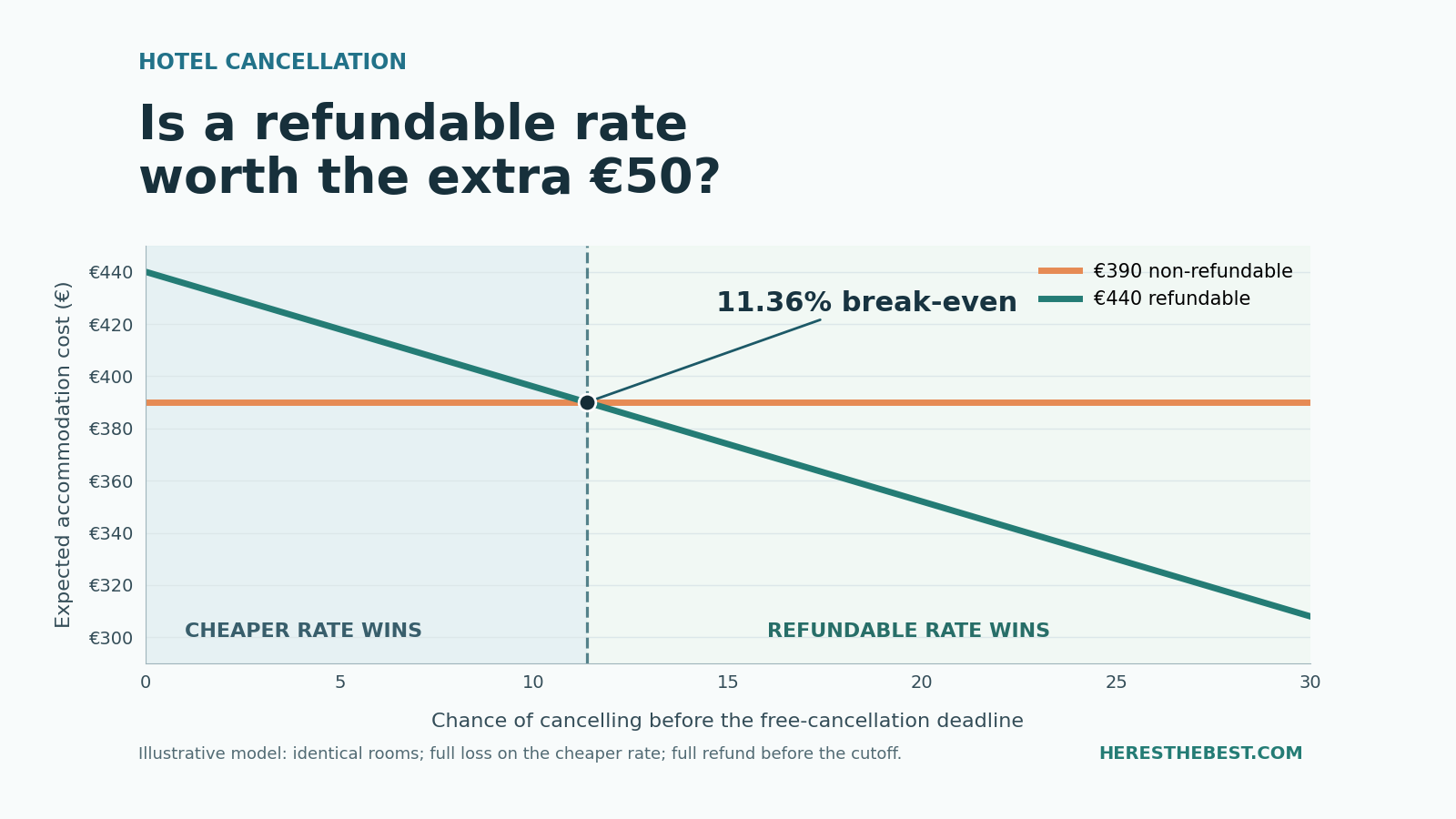
For identical rooms priced at €390 non-refundable and €440 fully refundable, with a full €390 penalty on the cheaper rate and a full refund on the flexible rate if you cancel in time, the break-even chance of timely cancellation is 11.36%. The extra variables below can change the answer.
Check these first: the exact refund deadline; penalties both before and after it; prices with locally payable taxes; whether you can safely rebook; and what you must pay now.
The baseline: why the break-even point is 11.36%
Assume two offers for the same nights, room, occupancy, included meals and taxes. If you stay, you pay €390 or €440. If you cancel before the flexible rate’s deadline, you lose €390 on the cheaper offer but receive the full €440 back on the other. No insurance, price change or other charges apply.
Expected non-refundable cost: €390
Expected refundable cost: €440 × (1 − p)
Break-even: p = (440 − 390) / 440 = 11.36%
Here p means the probability of cancelling during the fully refundable window. At 5%, the expected flexible cost is €418, so the cheaper rate wins by €28. At 15%, the expected flexible cost is €374, and it wins by €16. These are averages across possible outcomes: if you actually stay, the flexible booking still costs €440.
Why not divide the €50 premium by €390? Because in this model the flexible €50 premium is not paid when you cancel in time and receive a full refund. The calculation compares expected cash outflow in every outcome, rather than adding a premium that does not exist in the cancelled outcome.
The chart in the featured image shows the full-penalty, full-refund example. It does not model late cancellation or insurance.
Compare your actual booking terms
All figures are examples until you replace them. Calculations run entirely in your browser.
This tool compares three mutually exclusive outcomes: staying, cancelling before the flexible deadline and cancelling after it. Any rebooking savings are conditional, and insurance reimbursements are estimates. It does not estimate borrowing costs, penalties outside the inputs or personal risk aversion.
1. A one-night penalty changes the calculation
A room advertised as non-refundable can be subject to a full penalty, whereas another rate might charge only the first night on cancellation. The details are contractual; do not infer a penalty from a marketing badge. Booking.com states that the property’s cancellation policy determines any fees and points travellers to the booking confirmation for the exact terms. Source: Booking.com FAQ.
| Illustrative booking terms | Threshold |
|---|---|
| €390 vs €440; lose all €390 if you cancel | 11.36% |
| €390 vs €440; lose €195 if you cancel | 20.41% |
| €240 vs €250; lose all €240 if you cancel | 4% |
In the second example, the formula is premium / (premium + actual loss) = €50 / (€50 + €195). Your cancellation loss, not just the advertised room price, determines how much flexibility is worth. If the refundable rate also carries an early penalty, use its actual amount in the calculator instead of applying this shortcut.
2. The free-cancellation deadline matters more than the badge
Suppose the refundable rate allows free cancellation until five days before arrival. Your employer will approve your leave four weeks in advance, but an airline may cancel your flight the night before departure. Those uncertainties belong in different time windows.
- Before cutoff: The flexible booking may cost €0 to cancel. The cheaper rate may still charge you.
- After cutoff: The flexible rate may charge one night, several nights or the full stay. Check the actual wording.
- At check-in: You pay the total price of the rate you use, including any mandatory charges payable locally.
Our calculator therefore separates your estimated chance of early and late cancellation. The chance of using the room is what remains. If your main risk emerges after the deadline, a flexible label can have far less value than expected. Enter the actual late penalty for each rate; never assume free cancellation survives until check-in.
3. A refundable booking can be an option to rebook at a lower price
Refundability can offer a second kind of value. Imagine your €440 flexible room remains cancellable, and an otherwise equivalent room becomes available for €400 before the cutoff. You might save €40 by securing the replacement and only then cancelling the original if the hotel’s/platform’s conditions permit it.
That is an opportunity, not a promise. Availability can disappear, the replacement may exclude breakfast, the new booking may have stricter conditions, and foreign-exchange or payment fees may offset a price drop. Keep the rate’s genuine equivalence and ability to cancel in focus.
The tool lets you specify the probability of finding and successfully obtaining a cheaper equivalent offer, conditional on still travelling, plus a potential saving. In a simplified model, a 50% success probability and €80 saving represents €40 of average saving on stays; it does not apply to cancellations.
4. Pay now and pay at property are not cancellation policies
A pay-at-property rate can still charge a cancellation fee. A prepaid booking can sometimes be refundable until a specified date. Booking.com distinguishes advance payment, pre-authorisation and cancellation terms, and explains that extra taxes depend on the room and local rules. Source: Booking.com payment and pricing FAQ.
- €390 paid today: On a prepaid cheaper rate, the cash is unavailable before the stay.
- €440 paid at check-in: A flexible rate may let you retain cash until arrival, although a deposit or card hold may still apply.
The calculator accepts the amount due now for each rate, including partial prepayment. Those amounts describe cash tied up, not an extra cost in the expected-spending result. Confirm the deposit, card hold and refund timing separately.
Likewise, include mandatory local taxes payable when you stay rather than comparing nightly headline rates. In this model those taxes are charged only when you stay. If your specific reservation makes a tax or fee payable after cancellation, fold that into the corresponding penalty instead.
5. Travel insurance changes the loss, not the cancellation policy
Travel insurance is not a universal “cancel for any reason” switch. The Association of British Insurers explains that cancellation cover is typically limited to particular circumstances and may only pay after you have tried to recover costs from the airline or accommodation provider. The U.S. National Association of Insurance Commissioners similarly distinguishes ordinary covered-reason insurance from optional, often partial, “cancel for any reason” protection. ABI · NAIC, June 2026.
Suppose a €390 cancellation charge occurs. Your policy covers the reason, has a €50 excess and reimburses 100% of the remainder up to a €300 claim cap. The payout under that illustrative rule is €300, not €390. Your unrecovered loss is €90, plus any insurance premium already paid. If the reason is not covered or you do not meet the policy’s conditions, the payout may be zero.
In the calculator, you can enter the share of cancellation scenarios that meet the policy’s covered-reason rules, the reimbursement rate, excess, cap and premium. This is a scenario estimate, not an insurer’s coverage decision. It assumes you purchase the same insurance policy whichever room you choose; compare its premium separately if you are considering buying insurance for only one option. Actual eligibility, documentation and reimbursement order depend on the policy.
Three decisions a one-line “always book refundable” rule gets wrong
The deadline misses your real risk
A refund cutoff five days before check-in offers little protection when the event you fear is a last-minute flight cancellation. Read late penalties and transport cover before buying flexibility.
The price gap is tiny
If the total prices are €240 and €250 with full-loss versus full-refund terms, the break-even timely cancellation chance is only 4%. Ten euros can buy a meaningful option.
The cheaper rate has a limited penalty
When you would lose only a single €195 night rather than the entire €390 booking, a €50 premium needs a considerably greater chance of timely cancellation to win on expected spend.
Expected value is not the only criterion. A household unable to absorb a €1,000 loss may rationally prefer paying more for certainty even if the cheaper rate has the lower mathematical average. The calculator helps expose the trade-off; it cannot set your tolerance for risk.
The eight-line booking check you can use on your phone
- Same room, guests, nights, meals and included amenities?
- Final price for each rate, including mandatory booking fees?
- Taxes/charges paid locally on arrival?
- Exact free-cancellation date, time and time zone?
- Penalty for cancelling before and after that cutoff?
- Any deposit, prepayment or card pre-authorisation?
- Can you safely rebook an equivalent room before cancelling?
- Does your specific insurance cover the reason, penalty, excess and claim deadline?
Save a screenshot of the policy shown at checkout and retain the confirmation. Booking.com says a cancellation email should follow a completed cancellation; its help page advises following up if it does not arrive. Booking.com FAQ.
Can you simply cancel within 14 days after booking?
For a hotel reservation for specific dates, do not assume the general EU 14-day online-shopping withdrawal period applies. The European Commission’s Your Europe guidance explicitly lists date-specific hotel bookings among the exceptions. What you can cancel and when will therefore depend on the booking terms and other applicable consumer protections. Your Europe: withdrawal exceptions.
What we would check before choosing
Start with the actual penalty at the time you would realistically know the trip cannot happen. Then look at the time window, all-in stay costs, potential repricing and whether insurance would truly reimburse the loss. If those inputs are uncertain, use conservative assumptions and compare several scenarios, rather than trusting one precise-looking percentage.
A good refundable rate buys a usable right to change your mind. The best one is not necessarily the rate with the longest “free cancellation” label or the lowest premium; it is the one whose protections match your trip’s risks.
For the rest of your trip costs, see our practical trip-budget method. To capture deadlines and dependencies across several choices, see our decision-planning guide.
Method and sources
Research date: 1 November 2026. All hotel prices, probabilities and insurance examples are invented to demonstrate arithmetic, not observed market rates. The model considers staying, cancelling before a flexible cutoff and cancelling after it; it does not forecast actual cancellation probability or policy approval. Read the specific provider’s contract before booking.