
Last updated: October 19, 2026
A familiar masterpiece becomes more interesting when you know where to look. In Hokusai’s Great Wave, start with the boats rather than the crest. In a Renaissance portrait, a small wheel can tell you who the sitter represents. The best online museum collections give you the image and the information needed to make that second discovery.
These eight destinations offer different ways into art, objects and film. Each has a specific work to open, a detail to investigate and a reason to use that collection. They are object catalogues, not eight virtual walks through museum buildings. If you only have one sitting, use the three-work route below.
Eight collections, eight starting points
| Start here | Look for |
|---|---|
| The Met Great Wave |
Scale |
| Rijksmuseum Night Watch |
Light |
| Smithsonian Apollo 11 suit |
Design |
| Chicago La Grande Jatte |
Marks and distance |
| Cleveland Saint Catherine |
Conservation |
| National Gallery Ginevra de’ Benci |
Identity |
| British Museum Rosetta Stone |
Three scripts |
| Europeana Voyage sur Jupiter |
Early film |
The Met: discover the small subject inside the big image
Open Katsushika Hokusai’s Under the Wave off Kanagawa, c. 1830-32. Find the three boats, then Mount Fuji. The mountain looks tiny beside the wave. The Met’s interpretation draws attention to that manipulation of perspective; its enlarged image lets you examine it for yourself.
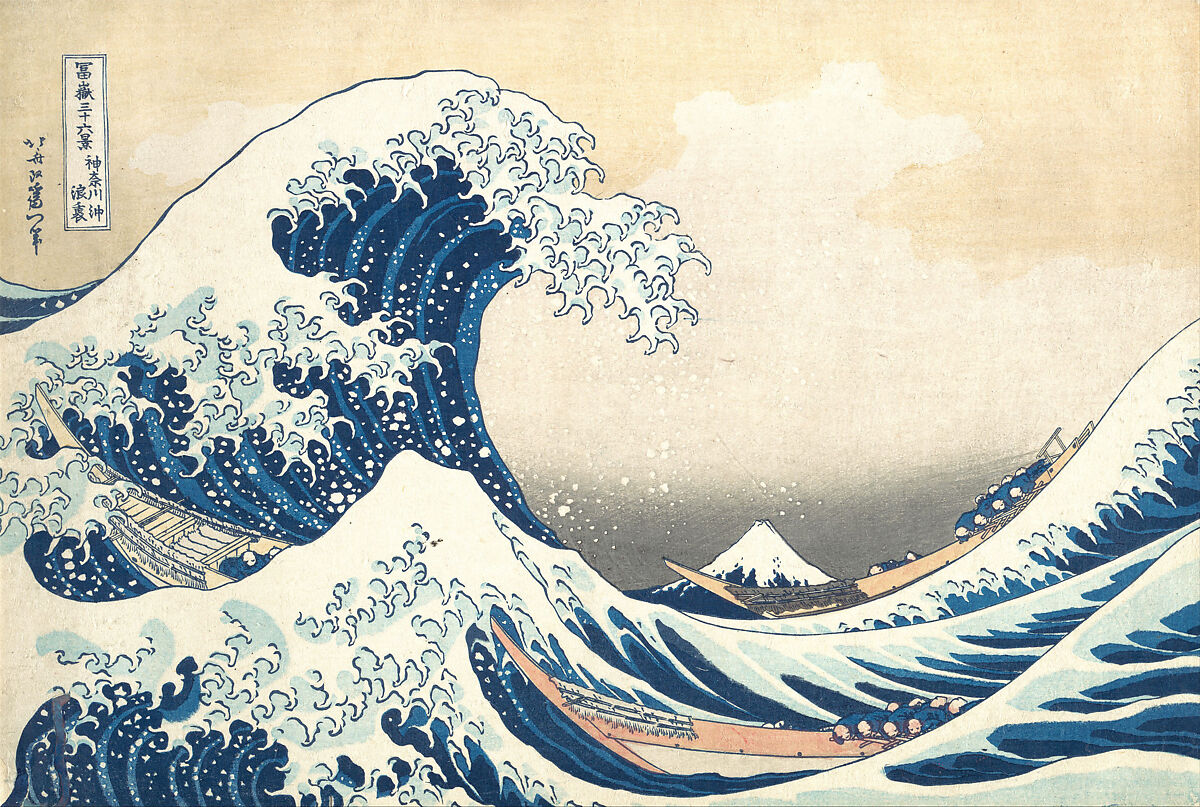
Why this collection: the record combines the image with materials, provenance and related works. From here, the collection can take you into prints, textiles, instruments or ceramics rather than only more famous paintings. Choose it for breadth; choose the three-work route if that breadth becomes distracting.
Rijksmuseum: follow the light through The Night Watch
Rembrandt’s The Night Watch (1642) is more than a crowded group portrait. Find the captain’s gesturing hand, the brightly lit girl and the dog near the right-hand side. The museum explains how the figures appear to be preparing to march.
Why this collection: the dedicated high-resolution view gives this exercise somewhere to go beyond a thumbnail. Compare the attention given to those three details, then pull back to the whole painting. The collection’s visitor stories and personal-gallery feature offer a next step if you want to assemble your own selection. This is a focused Dutch-art starting point, not a substitute for the Met’s cross-cultural breadth.
Smithsonian: read a spacesuit as a piece of design
Start with the National Air and Space Museum’s Apollo 11 spacesuit worn by Neil Armstrong, inventory A19730040000. Look at the coloured connectors, neck ring and wrist fittings before reading the materials list. The catalogue identifies aluminium components alongside beta cloth, rubber, nylon and plastic: an invitation to think about how different parts solve different problems.
Why this collection: the object record and its photographs connect engineering with human history. That makes Smithsonian a useful choice for someone who enjoys museums but does not primarily want paintings. Its Open Access portal also includes reusable assets across many collections. The spacesuit record itself says Usage conditions apply; it is a viewing recommendation, not a licence to republish its photographs.
Art Institute of Chicago: see Seurat at two distances
Open Georges Seurat’s A Sunday on La Grande Jatte – 1884. The date in the title is not the whole production history: Chicago dates the painting to 1884-86, with the border added in 1888-89. Inspect a small patch of grass or clothing, then return to the full scene. Dots and dashes resolve into figures when viewed at a distance.
Why this collection: the collection search has a Color filter as well as artist, medium and public-domain filters. After Seurat, use colour as your next search criterion and compare how another artist builds a scene. That is a more revealing exercise than moving through a list of names. The object page also identifies this image as CC0.
Cleveland: compare a painting with its conservation record
In Pier Francesco Foschi’s Portrait of a Woman as Saint Catherine, c. 1560, find the spiked wheel. The museum identifies it as Catherine’s attribute. Next open Conservation Images and the full conservation statement. Compare the images before using the technical explanation to interpret the differences.
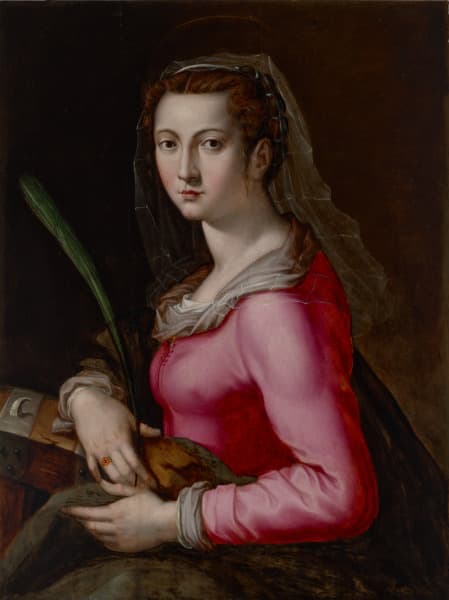
Why this collection: here the added value is the investigation of the object, not just its reproduction. Cleveland’s collection guide also explains filters for highlights, open-access works and videos. Not every entry has the same depth of supporting material; this portrait is a concrete place to begin.
National Gallery of Art: find the clue behind Leonardo’s sitter
Open Leonardo da Vinci’s Ginevra de’ Benci, c. 1474-78. The dark foliage behind the sitter is juniper. The gallery connects the Italian word ginepro with her name. Notice how the pale face stands out against that dark plant before reading the curator’s commentary.
Why this collection: the record includes a visual description, an audio transcript and a Look Closer section. One detail there identifies a fingerprint associated with Leonardo’s modelling of the paint. This is a good choice when you want explanations attached to particular parts of an image, rather than an open-ended search. The page also explicitly marks its media as public domain.
British Museum: approach the Rosetta Stone as a document
Open the Rosetta Stone record, EA24. The object is dated 196 BCE and contains a decree in hieroglyphic, Demotic and Greek scripts. Compare the three blocks of writing. Then read the inscription notes: what looks like a monument to translation was a decree concerning Ptolemy V.
Why this collection: the catalogue separates physical description, inscriptions, findspot, collecting history and bibliography. Those distinctions help you ask not just what an object looks like, but what different kinds of evidence tell us about it. The dense record rewards a specific question; it is less suitable for a quick, lightly guided scroll. Its photographs have their own reuse terms.
Europeana: let an early film take you beyond art museums
Open Segundo de Chomón’s 1909 Voyage sur Jupiter, displayed in the English interface as Travel on Jupiter. Filmoteca de Catalunya supplies the record. Its description follows a king whose fascination with astronomy becomes a dream journey by ladder. Use that premise to consider how early cinema visualised impossible travel.
Why this collection: Europeana connects records from different institutions, including film archives. From this item, the related entries lead to other Chomón films, not just paintings with similar colours. It is the useful outlier in this selection, an aggregator rather than a museum. The record marks the film Public Domain; its embedded Vimeo player requires third-party-content consent. Europeana’s own guide confirms the film’s attribution and rights.
A 45-minute route: three works, three small clues
These are suggested time allocations, not a measured completion time. You need only the linked records; no account or personal gallery is required.
- 0-15 minutes: The Great Wave. Locate the boats and mountain. Ask how changing their size would change the picture’s sense of danger.
- 15-30 minutes: Saint Catherine. Find the wheel, read its meaning, then compare the conservation views. Separate what you can see from what the museum’s research explains.
- 30-40 minutes: Ginevra de’ Benci. Find the juniper. Compare a clue to a person’s name with the saint’s identifying attribute.
- 40-45 minutes: choose one of the three works to send to a friend. Include the official link and one detail they might otherwise miss.
The route moves from scale, to a religious symbol, to a visual play on a name. It gives you three different reasons to return to an image after the first glance. For a physical visit, use our museum-day planning guide; a separate museum-pass comparison addresses admission costs rather than digital access.
Viewing is not the same as permission to republish
Check the rights label on the exact image you want. The two images reproduced here have explicit public-domain or CC0 permission on their museum records. That does not extend to every image, logo or piece of text on either website. Keep the creator, title, institution, accession number and source link with a downloaded file.
For the relevant policies, see The Met, Chicago, Cleveland, the National Gallery and Europeana’s rights FAQ. Smithsonian’s open-access assets and restricted collection photographs must also be distinguished.
How we checked this
Checked October 18, 2026. The linked institutional records support the object identities, dates, observations and rights notes. The selection matches different reader interests; it is not a ranking of museum prestige or an exhaustive usability test. Image credits refer to the particular files reproduced here. Our route and its timing are editorial suggestions.