Last updated: April 12, 2026
Jazz documentaries are most valuable when they do more than celebrate legends everybody already knows. The strong ones help you hear structure, place, improvisation, and tension more clearly — after a good one, the music stops sounding like a vague mood and starts sounding like a set of decisions made by real people in real rooms under real pressure.
This guide covers the best jazz documentaries to stream in 2026 with runtime, current streaming direction, what each film actually teaches, where each one falls short, and what to listen to immediately after watching. Availability shifts by country and rights window, so treat the platform notes as planning guidance and confirm them locally before building a watchlist around one service. The list is organized by experience level and intent — beginner overview, artist portrait, scene and label context — so you can start exactly where you need to.
Watch a fast introduction before choosing where to start
This video works well as a companion because it frames jazz through listening habits and historical context rather than turning the genre into homework.
Quick answer
The best jazz documentaries in 2026 are the ones that make the music easier to hear, not just easier to admire. Jazz by Ken Burns is still the broad historical map for total beginners. Blue Note Records: Beyond the Notes is one of the strongest single films for label culture and artistic standards. Chasing Trane is the right focused portrait for someone ready to go deeper on one figure. Summer of Soul is essential for understanding jazz inside a larger Black cultural moment. Miles Davis: Birth of the Cool is where to go once you know enough to want specificity. I Called Him Morgan is one of the strongest films here for viewers who are already listening and want something less canonical.
If you are building the arts and culture pillar of this site, pair this with best food documentaries 2026 for another streaming list built around genuine use-value, or with How to Plan a Museum Day Without Burnout for the same pacing-and-attention logic applied to visual culture.
Quick pick by starting point and experience level
| If you want… | Watch this | Skip this for now |
|---|---|---|
| A broad historical map (complete beginner) | Jazz — Episodes 1–4 to start | I Called Him Morgan — lands better once you know the Blue Note and hard-bop world |
| One strong portrait, accessible to beginners | Chasing Trane | Thelonious Monk: Straight, No Chaser — better once you know the music |
| Label culture, craft, visual identity | Blue Note Records: Beyond the Notes | Jazz — too broad for this specific question |
| Jazz inside a larger cultural/political moment | Summer of Soul | Chasing Trane — focused on one figure, not a cultural panorama |
| The most complex, most covered figure in jazz | Miles Davis: Birth of the Cool | Jazz Burns — it spreads Miles too thin across 19 hours |
| A film that rewards close attention (intermediate+) | I Called Him Morgan | Jazz — too broad if you already want a more formally ambitious film |
| Jazz as live experience, not biography | Jazz on a Summer’s Day | Any talking-head career retrospective |
The documentaries: what they teach, where they fall short, what to listen to after
Jazz (2001) — Ken Burns / PBS
Runtime: 19 hours total (10 episodes). Platform: PBS in the US; rental and purchase options vary elsewhere. Best approach: Episodes 1–4 cover 1900–1950 and are the most accessible starting block; episodes 5–10 become more contested in their treatment of post-bop and free jazz.
What it teaches: The broadest available timeline of jazz history, from New Orleans origins through swing, bebop, and modal jazz. Strong on biography, recording sessions, city geography (New Orleans, Chicago, New York), and the relationship between jazz and Black American history. It gives beginners chronology, names, and enough historical scaffolding to make any subsequent watching easier to place.
Where it falls short: The series became controversial on release for its treatment of jazz after 1960. Critics, notably Gary Giddins and many musicians, argued that Burns and Marsalis effectively end the story at Miles Davis and Coltrane, treating free jazz, fusion, and contemporary jazz as footnotes or mistakes. The later episodes are noticeably less generous to the music’s evolution. Watch it as a starting map, not as a final word.
After watching: Start with the canonical albums that the film references most: Louis Armstrong’s Hot Fives and Sevens, Duke Ellington’s 1940–42 band recordings, Charlie Parker’s Jazz at Massey Hall, Miles Davis’s Kind of Blue. These four cover the main eras Burns spends most time on.
Blue Note Records: Beyond the Notes (2018)
Runtime: 90 min. Platform: rotating subscription and rental availability depending on region. Director: Sophie Huber.
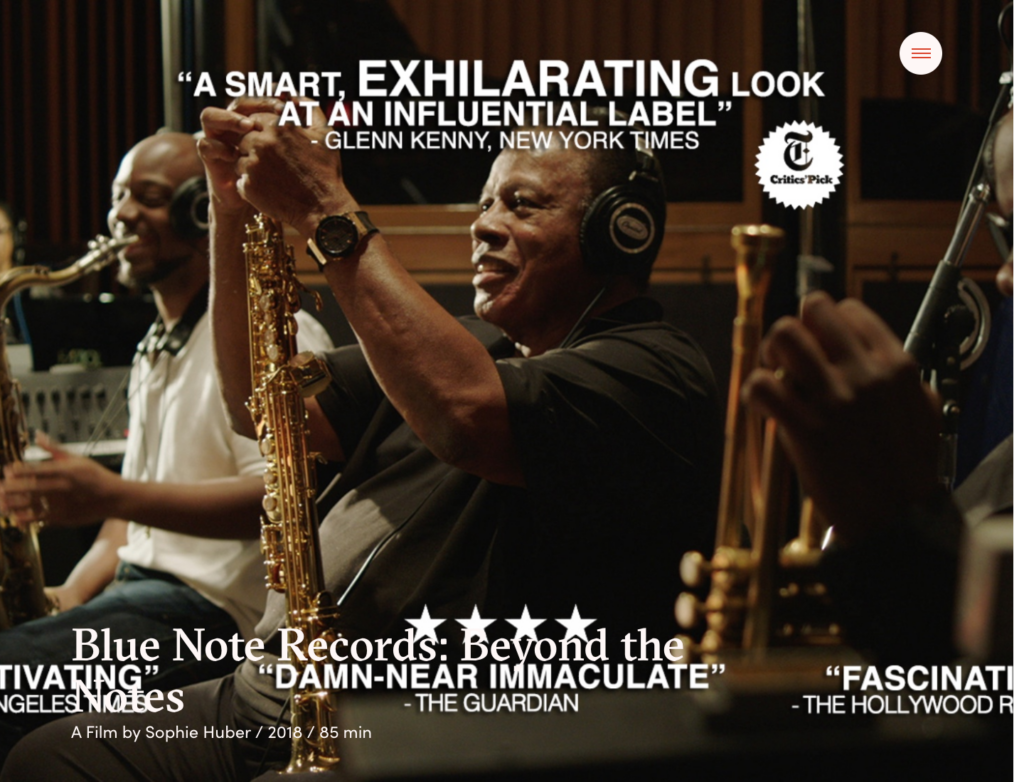
What it teaches: How a label shapes a music scene — not just through signing artists, but through recording philosophy, cover art design, session structure, and the specific listening environment of a studio. Blue Note under Alfred Lion and Francis Wolff built a sound and an aesthetic identity that is still immediately recognizable. The documentary shows that jazz culture was also visual culture, labor culture, and design culture. Interviews with Herbie Hancock, Wayne Shorter, and Norah Jones (who revived the label in the 2000s) ground the film in both historical depth and contemporary relevance.
Where it falls short: The contemporary section — covering Blue Note’s commercial revival from the 1980s onward — is noticeably thinner and more promotional in tone than the historical material. The film is substantially better on the Lion/Wolff era than on the label’s current identity.
After watching: Build a Blue Note listening session: Art Blakey and the Jazz Messengers (Moanin’), Thelonious Monk (Genius of Modern Music), John Coltrane (Blue Train), Lee Morgan (The Sidewinder), Herbie Hancock (Maiden Voyage). These five records represent five different decades of the label’s peak years and sound completely different from each other — which is the point the documentary makes best.
Chasing Trane: The John Coltrane Documentary (2016)
Runtime: 98 min. Platform: check local subscription and rental options; availability varies by region. Director: John Scheinfeld.
What it teaches: Coltrane’s development from a working musician in bebop groups (Miles Davis, Thelonious Monk) through the “sheets of sound” period, the quartet years, and A Love Supreme, into the free jazz experiments that divided audiences before his death at 40 in 1967. The film connects his spiritual seriousness to the music’s actual structural changes — the move from bebop language to modal improvisation to harmonic deconstruction is explained well enough that a listener with no theory can follow the arc. Interviews include musicians who played with him and musicians who were shaped by him, including Carlos Santana and Common.
Where it falls short: The film is reverential enough that it can feel like hagiography in the late sections. The free-jazz period — Ascension, Interstellar Space, the Impulse Records years — is treated carefully but quickly. Viewers who want to understand why that music was genuinely polarizing and not just “ahead of its time” will need to go elsewhere (Gary Giddins’s writing is the supplement).
After watching: Listen in sequence: Blue Train (Blue Note, 1957) → Giant Steps (Atlantic, 1960) → A Love Supreme (Impulse!, 1965) → Meditations (Impulse!, 1966). That four-record sequence shows the actual range of change across a decade — and the jump from A Love Supreme to Meditations is the most dramatic creative shift on the list.
Summer of Soul (…Or, When the Revolution Could Not Be Televised) (2021)
Runtime: 117 min. Platform: usually found on major streaming platforms or rental, depending on region. Director: Questlove.
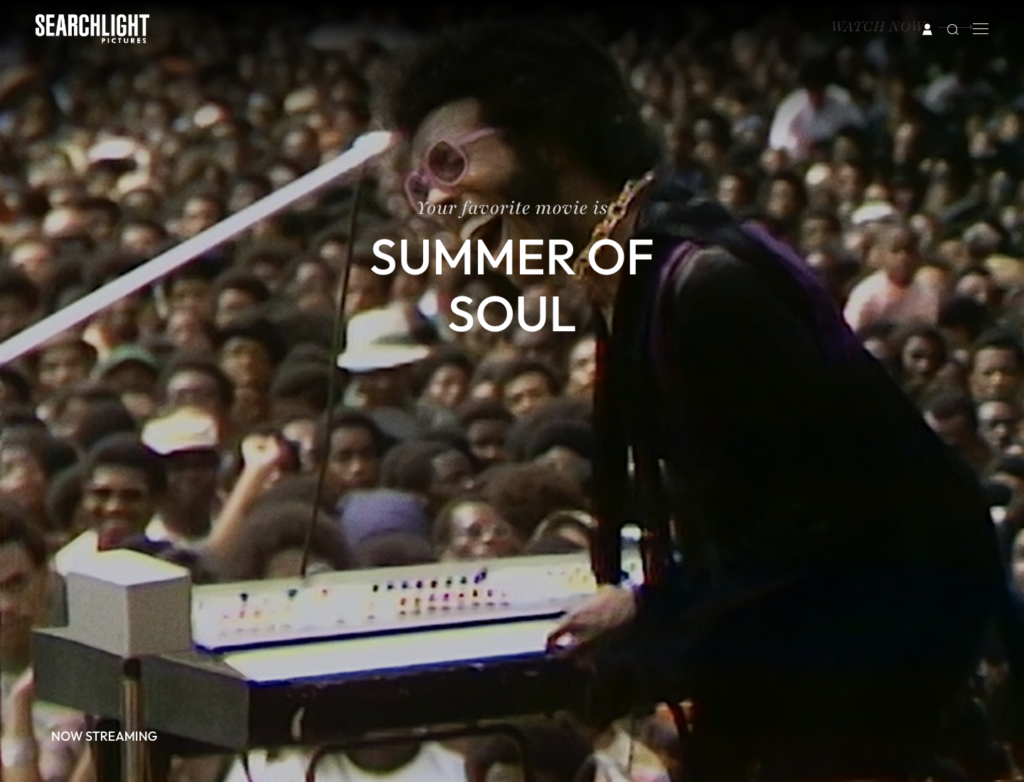
What it teaches: The 1969 Harlem Cultural Festival — a summer concert series in Mount Morris Park that drew 300,000 attendees over six weeks, was filmed professionally by Hal Tulchin, and then sat in a basement for 50 years while Woodstock became the defining cultural event of that summer. The film restores that story with extraordinary archival footage of Sly and the Family Stone, Stevie Wonder, Nina Simone, Mahalia Jackson and Mavis Staples performing together, and David Ruffin. Jazz, soul, gospel, R&B, and funk all appear — this is not a pure jazz film, but it is essential for understanding what Black American musical culture looked like in the same year Miles Davis was recording Bitches Brew.
Where it falls short: The film is not analytically deep about any individual artist or musical tradition — its strength is panorama, not focus. If you want to understand a specific artist’s development, you need a more focused portrait. But as a corrective to the Woodstock-centric narrative of 1969 cultural history, it is irreplaceable.
After watching: Nina Simone’s I Put a Spell on You and Pastel Blues; Sly and the Family Stone’s Stand!; Stevie Wonder’s early live recordings. The jazz-adjacent path: Black Music by Amiri Baraka (the book, not a film) as background reading on the cultural politics of the same period.
Miles Davis: Birth of the Cool (2019)
Runtime: 115 min. Platform: subscription and rental availability varies by region. Director: Stanley Nelson.
What it teaches: Miles Davis is the most covered figure in jazz documentary history, and most profiles collapse under the weight of the legend. This one works because it structures his career around creative reinvention — the Birth of the Cool sessions (1949–50), the first great quintet (1955–59), Kind of Blue (1959), the second great quintet (1964–68), the electric period (Bitches Brew, 1970) — and does not skip the harder parts: addiction, domestic violence, commercial periods, the long silence of the late 1970s. Interviews with musicians who played in his bands provide the best texture.
Where it falls short: The electric and fusion period — arguably the most sonically interesting and most historically neglected part of Miles’s career — gets rushed treatment in the final act. The film prioritizes the canonical acoustic Miles at the expense of the 1970s work that influenced hip-hop, electronic music, and much of what came after. For a fuller picture, supplement with the 1990 documentary Miles Davis: A Tribute and any writing by Greg Tate.
After watching: The essential five: Birth of the Cool (1957 compilation) → Kind of Blue (1959) → E.S.P. (1965, second great quintet) → In a Silent Way (1969) → Bitches Brew (1970). That sequence covers every major era the film discusses and shows why he kept changing rather than repeating what already worked.
I Called Him Morgan (2016)
Runtime: 91 min. Platform: often found on Criterion Channel, Mubi, or rental services depending on region. Director: Kasper Collin.
What it teaches: Lee Morgan was a hard-bop trumpeter who recorded for Blue Note through the 1960s, had a major commercial success with The Sidewinder (1963), struggled with addiction, and was shot and killed by his common-law wife Helen More in a New York club in 1972. He was 33. The film’s structural device — a 1996 audio recording of Helen More’s own account of what happened — gives it an intimacy and a moral complexity that most jazz biography never achieves. It is as much a film about a relationship, addiction, and grief as about music, and it is one of the most formally accomplished jazz documentaries ever made.
Where it falls short: The film assumes some familiarity with the hard-bop era and with Blue Note’s recording culture. Viewers who come in knowing nothing may find the emotional impact arrives before the musical context does. Watch Blue Note Records: Beyond the Notes first and the Morgan film lands at a different register.
After watching: The Sidewinder (1964), Cornbread (1965), Caramba! (1968). Three records that span his most productive period and sound nothing like the tragedy that ended it — which is part of what makes the film linger.
Thelonious Monk: Straight, No Chaser (1988)
Runtime: 89 min. Platform: often available on Criterion Channel or via digital rental, depending on region. Director: Charlotte Zwerin. Producer: Clint Eastwood.
What it teaches: Monk is one of the most technically distinctive pianists in jazz history and also one of the hardest to approach without help. His rhythm is deliberately awkward, his silences are structural, and his compositions resist the clean resolution that makes other jazz more immediately legible. This documentary, shot partly by camera teams who traveled with him in the late 1960s, captures him in rehearsal, performance, and daily life in a way that makes his strangeness feel coherent rather than eccentric. You understand after watching it why his music sounds the way it does.
Where it falls short: The film underserves the context of Monk’s mental health — he suffered from what was likely bipolar disorder and spent the last years of his life in near-total silence. The film gestures at this without engaging it directly, which is both understandable for 1988 and a limitation for a contemporary viewer who would benefit from that context.
Best for: Intermediate viewers who already know Monk’s name and have tried to listen and felt confused. This film is the best single gateway into his music.
After watching: Monk’s Music (1957), Brilliant Corners (1956), Thelonious Himself (1957, solo piano). The solo piano record is the most direct path from the documentary into the music because you can hear exactly what the film’s rehearsal footage shows.
Jazz on a Summer’s Day (1959)
Runtime: 85 min. Platform: often available on Criterion Channel, specialty streamers, or rental services depending on region. Director: Bert Stern.
What it teaches: The 1958 Newport Jazz Festival — with Louis Armstrong, Thelonious Monk, Mahalia Jackson, Chuck Berry, Dinah Washington, Gerry Mulligan, Chico Hamilton, and Anita O’Day. It is less a documentary than a filmed concert, but the result is one of the most important jazz films for understanding the genre as a live, social, outdoor experience rather than as a prestige recording. Anita O’Day’s two-song sequence near the opening is as good as jazz performance on film gets.
Where it falls short: It is an observational film, not an analytical one. If you want context about what each artist represented historically, you will not find it here. It is purely experiential — the visual counterpart to a live album.
Best for: Any viewer, any experience level. It is one of the most enjoyable jazz films on this list precisely because it expects nothing from you except the willingness to watch and listen.
After watching: Anita O’Day’s Anita (1955), Louis Armstrong’s Satch Plays Fats (1955), Thelonious Monk’s live recordings from the same era. Newport recordings from Monk, Miles Davis, and Bill Evans are also available on separate live albums that sound directly continuous with this film.
Beginner path versus intermediate path
Complete beginner path (knows jazz is a genre, has heard Miles Davis’s name, not much more): Start with Jazz episodes 1–4 for timeline and names. Then watch Chasing Trane to make one specific figure concrete. Then watch Summer of Soul to place the music inside a cultural and political context. At that point, listen to ten albums and come back to the intermediate path later.
Intermediate path (knows some names, has listened to a few albums, wants to go deeper on scenes, figures, and context): Start with Blue Note Records: Beyond the Notes to understand how label culture shapes music. Then Miles Davis: Birth of the Cool for the most complex single-figure portrait. Then I Called Him Morgan for formal ambition and the underside of the scene. Then Thelonious Monk: Straight, No Chaser if Monk’s music has remained opaque and you want to change that.
What not to do: Watch all eight in two weeks and then try to listen to jazz from scratch. The documentaries produce diminishing returns without listening between them. Watch one, listen for three to seven days, then watch the next. This is the practice that converts documentary watching into actual music knowledge.
Streaming availability: what to know before planning an evening
Streaming rights for jazz documentaries shift frequently. Criterion Channel is often one of the best places to look for older and less mainstream titles such as Jazz on a Summer’s Day, Straight, No Chaser, and sometimes I Called Him Morgan. Mubi can overlap on a rotating basis. More recent productions are often easier to find on large subscription platforms or via digital rental, but country-by-country availability changes often enough that it is safer to check before planning around one title.
For any title not immediately in your subscription library: check JustWatch for the current streaming location in your country, then rent directly if needed. Renting a specific film you genuinely want usually beats waiting months for a rights change that may never come.
Jazz by Ken Burns is available directly through PBS in the US. Outside that ecosystem, availability is more variable. Given its 19-hour length, it is the one title where access is less the obstacle than commitment — start with episodes 1–4 and reassess.
FAQ
What is the best jazz documentary for beginners?
Jazz by Ken Burns (episodes 1–4) is the broadest and most accessible starting map. Chasing Trane is the better choice if you want something you can finish in one sitting that still gives you a legible first portrait of a major figure. The Burns series is 19 hours total; if that feels daunting, go to Coltrane first and return to the historical survey later.
What jazz documentary should I watch if I only have time for one?
If you want breadth, Jazz episodes 1–4. If you want depth on one figure, Miles Davis: Birth of the Cool — it covers the most influential figure in the genre’s history across multiple creative periods in 115 minutes. If you want something that expands beyond the usual canon and places jazz in a social context, Summer of Soul.
Is Summer of Soul really a jazz documentary?
Not in the narrowest sense — it covers soul, gospel, R&B, and funk alongside jazz. But it belongs on this list because it places jazz performance (Nina Simone in particular) inside the Black cultural politics of 1969 in a way no pure jazz documentary does. It is one of the few music films that genuinely changes how you understand why the music existed and who it existed for.
What should I listen to after watching a jazz documentary?
Each film section above includes specific post-watch listening paths. The general rule: pick three to five albums directly mentioned in the film and listen to them in the week after watching. Without that step, the documentary becomes biographical trivia rather than actual musical understanding. The albums give the biography a sound.
What is the best jazz documentary for someone who already knows the basics?
I Called Him Morgan is the most formally accomplished film on this list and assumes you already know the Blue Note era well enough to appreciate the specificity of Lee Morgan’s story. Thelonious Monk: Straight, No Chaser is the best gateway into a figure most intermediate listeners know by name but have not yet made sense of musically.
What is wrong with the Ken Burns Jazz series?
The main critical objection — shared by Gary Giddins, many musicians, and most jazz scholars — is that the series treats jazz after 1960 as a decline narrative rather than a continuation. Free jazz, fusion, the electric period, and post-1970 developments are given minimal and sometimes dismissive treatment. The implication is that jazz peaked with Miles Davis and Coltrane and then lost its way. Most musicians and critics disagree strongly with that framing. Watch the Burns series as a first map; supplement with deeper reading or viewing on the post-1960 period before accepting its conclusions.
Where can I stream I Called Him Morgan and Jazz on a Summer’s Day?
Criterion Channel is often the first place to check for both, and Mubi sometimes overlaps on rotation. Direct rental is also common, but the exact platform and price depend on country and timing. If you are planning a focused jazz-film month, Criterion is often the cleanest starting point.
What jazz documentary is best if I care more about the music than the biography?
Jazz on a Summer’s Day (1959) is the right answer — it is essentially a filmed concert at Newport 1958 with minimal narration or biography. Anita O’Day, Louis Armstrong, Thelonious Monk, and Mahalia Jackson perform; the camera watches. It is 85 minutes of music without anyone explaining what you are supposed to feel about it. Blue Note Records: Beyond the Notes is the second-best answer if you want craft and aesthetic context without heavy biographical narrative.