Last updated: April 22, 2026
Food documentaries are most useful when they do more than make you hungry. The strong ones change how you travel, how you notice a market, or how you understand why one dish matters in one place and feels generic somewhere else. That is the standard this list uses: not “which title has the best photography” but “which title leaves you with something you can actually use.”
This guide covers the best food documentaries to watch in 2026 — what each one actually teaches, who it is for, what it cannot do, and how to use it before a trip. Streaming availability shifts by country and rights window, so treat every platform note as planning guidance and verify locally before building a watchlist around one service.
See which food documentaries are still worth your time
This video helps frame the list because it focuses on documentaries that still add context, not just glossy food imagery.
Quick answer: best food documentary by what you need
| Your goal | Start here | Why this one |
|---|---|---|
| Pre-trip city/street context | Street Food (season matching destination) | Neighborhood rhythm, vendor economics, daily food logic |
| Craft, discipline, standards | Jiro Dreams of Sushi | 81 min portrait of Japanese craft culture at its most extreme |
| Practical cooking principles | Salt Fat Acid Heat | Four-element framework you carry into every market and kitchen |
| Food as identity and cultural argument | Ugly Delicious | Authenticity as political debate, not culinary fact |
| Food history and diaspora | High on the Hog | How African American cuisine built American food — with evidence |
| Supply chain and food system reality | Rotten | Investigative look at honey, garlic, avocado, dairy industries |
| Science of cooking methods | Cooked | Fire, water, air, earth — why technique defines cuisine |
| Light pre-trip orientation, no friction | Somebody Feed Phil | Warm, enthusiastic city overview — thin on analysis, strong on mood |
If you are building a culture-first discovery system, food documentaries are one of the strongest entry points because they anchor abstract ideas to specific places, dishes, and people.
Food documentary types: what each category actually does
Not all food documentaries serve the same purpose. Knowing the category before you press play prevents the most common mistake — expecting travel advice from a chef biography, or expecting cultural depth from a city tour.
| Type | What it gives you | What it cannot give you |
|---|---|---|
| Chef portrait | Craft biography, creative process, restaurant philosophy | Practical travel info, affordable dining, neighborhood context |
| Street/vendor profile | City rhythm, vendor economics, food at daily-life level | Specific bookable recommendations, fine-dining context |
| Travel-food essay | Political and cultural context, mood of a place, curiosity framework | Prices, logistics, itinerary details |
| Principles/science | How cooking works, why flavors behave as they do, transferable knowledge | Destination info, restaurant names, trip planning |
| System/supply chain | What you are actually eating, industry economics, regulatory gaps | Travel context, emotional warmth, cultural narrative |
| Food history | How cuisine evolved, who built it, what was erased | Current restaurant scene, pricing, practical logistics |
Viewing order: where to start and what to watch next
The order matters more than the list. Watching six documentaries in random order produces noise. A deliberate sequence builds a framework where each title adds to what the previous one established.
| Step | Watch this | Why in this order |
|---|---|---|
| 1. Principles first | Salt Fat Acid Heat (4 episodes) | Gives you a tasting framework everything else builds on |
| 2. Street-level reality | Street Food (pick your destination season) | Applies those principles at vendor and neighborhood level |
| 3. Cultural argument | Ugly Delicious S1 (pizza + fried rice episodes) | Challenges the authenticity ideas you picked up in steps 1-2 |
| 4. History and erasure | High on the Hog S1 | Shows whose labor built what you have been watching |
| 5. Craft extreme | Jiro Dreams of Sushi | After broad context, the single-focus portrait hits differently |
| 6. System critique | Rotten (honey + avocado episodes) | Reframes everything you have watched through supply-chain reality |
This sequence works because each step complicates the previous one. Principles → application → argument → history → obsession → system. You do not need to follow it exactly, but watching a chef portrait first and a principles show last is backwards.
Streaming reality in 2026: what it actually costs and what to expect
Streaming availability changes constantly. A title on Netflix in one country may be rental-only in another, or gone entirely. The only reliable approach is to check before you commit to a viewing plan.
| Platform | Typical monthly cost | Availability risk |
|---|---|---|
| Netflix (Standard) | Country-specific; official page shows current plans after country selection — verify before subscribing | Medium — Netflix originals stay; licensed titles rotate by region |
| Max (formerly HBO Max) | US $9.99–$20.99 depending on tier — verify on max.com | High — Bourdain availability varies heavily by region |
| Apple TV+ | US $12.99 after trial — verify on apple.com/apple-tv | Low for originals — small catalog, stable |
| Amazon Prime Video | US $14.99 (Prime) / $8.99 (Video only) — verify on amazon.com | Medium — some titles included, others rental at $2.99–$5.99 |
| Digital rental (Apple/Google/Amazon) | $2.99–$5.99 per title typically | Low — rental availability is more stable than subscription |
The practical rule: before building a watchlist around one platform, check each title on JustWatch for your country. If a title is not on a service you already pay for, renting it for $3–5 is almost always cheaper than adding a new subscription for one documentary.
The documentaries: what they actually teach and where they fall short
Jiro Dreams of Sushi (2011)
Runtime: 81 min. Director: David Gelb. Platform: commonly available on Netflix and digital rental — verify for your region.
Ostensibly about Jiro Ono, an 85-year-old sushi chef with a three-Michelin-star restaurant in a Tokyo subway station. Actually about the logic of a life organized around one precise skill. The documentary is most useful for understanding how Japanese craft culture works — not just in sushi, but in any discipline that rewards repetition, temperature control, and elimination of everything non-essential.
What it teaches: What obsessive standards look like from the inside. Why Tokyo’s best restaurants are often small, inconvenient, and completely uninterested in variety. The relationship between a master and apprentices — why the apprentice path takes a decade before independent judgment is trusted.
Where it falls short: It does not teach you how to eat sushi affordably in Japan, how to book a counter, or what makes the difference between good and great sushi as a diner. It is a portrait of one extreme, not a dining guide. If you are heading to Japan, pair this with the guide to eating well in Japan on a budget for the practical side.
Street Food (2019–present)
Format: Series, 30–45 min per episode. Platform: Netflix in many regions. Creator: David Gelb.
One of the most travel-useful food documentary formats made. Each episode follows one street vendor in a city — connecting the dish to biography, neighborhood, and daily economic reality. Seasons cover Asia (Bangkok, Tokyo, Osaka, Delhi, Yogyakarta, Taipei, Hong Kong, Chiang Mai), Latin America (Mexico City, Lima, Buenos Aires, Rio, Bogotá), and the USA (New Orleans, LA, Portland, Miami, NYC, Chicago).
What it teaches: How food lives inside a city’s daily rhythm. Why certain dishes cost what they cost. What the economic life of a vendor looks like — which changes how you understand market pricing when you arrive. The Osaka and Bangkok episodes are among the best short watches for pre-trip food context.
Where it falls short: Vendors are not named in a way that makes them directly findable for most international visitors. Use the documentary to understand the category and neighborhood logic, then do separate research for specific stops.
Salt Fat Acid Heat (2018)
Format: 4 episodes, 40–50 min each. Platform: Netflix in many regions. Host: Samin Nosrat.
Each episode covers one fundamental element of cooking — salt (Japan), fat (Liguria, Italy), acid (Yucatán, Mexico), heat (US). Nosrat explains the principle using a specific food culture and geography, then shows how it works across cuisines. After watching, you will ask different questions at markets, restaurants, and cooking classes.
What it teaches: How to taste precisely. Why Japanese dashi, Italian cured fat, and Mexican lime serve the same flavor logic. How to identify what a dish is missing when it tastes wrong.
Where it falls short: No restaurant recommendations, no budget advice, no route planning. Entirely principles-focused — a strength for understanding, a limitation for trip logistics.
Ugly Delicious (2018–2019)
Format: 2 seasons, 45–55 min per episode. Platform: Netflix in many regions. Host: David Chang.
Each episode takes one dish — pizza, fried chicken, tacos, fried rice, steak — and follows it across cultures, immigration histories, and authenticity arguments. Season 1 is stronger; the pizza and fried chicken episodes are the clearest examples of the format at full capacity. The fried rice episode — covering Japanese, Chinese-American, and Southeast Asian variants — is one of the best pieces of food media on migration and cultural translation.
What it teaches: Why “authentic” is a political argument more than a culinary fact. How dishes travel, mutate, get claimed, and get contested. Why the best version of a dish in a city is often not the version the city claims to have invented.
Where it falls short: Essayistic and argumentative, not a practical guide. Chang is deliberately provocative — the show is better on diagnosis than resolution.
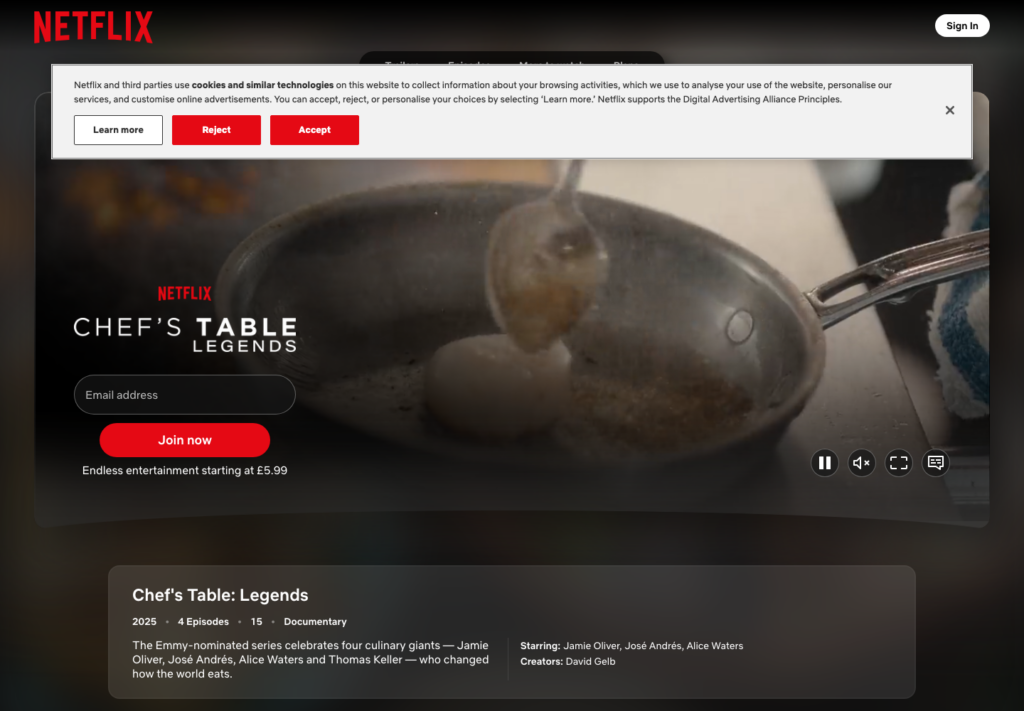
Chef’s Table (2015–present)
Format: Multiple seasons, 45–60 min per episode. Platform: Netflix in many regions. Creator: David Gelb.
Each episode profiles one chef from a single restaurant in cinematic, slow-moving format. Photography is exceptional; analytical depth varies enormously by episode. The strongest episodes: Season 1 Massimo Bottura (Modena — Italian food culture vs. avant-garde), Season 1 Francis Mallmann (Patagonia — fire, landscape, rejection of convention — the best episode in the entire series), Season 2 Grant Achatz (illness reshaping creative work), Season 4 Gaggan Anand (ambition and Asian fine dining). The pastry and BBQ seasons are noticeably weaker.
Where it falls short: Chef’s Table has a visual worship problem. The format treats every chef as a solitary visionary, erasing kitchen labor, economic scaffolding, and power dynamics. Watch it as portrait and craft biography, not as pre-trip research.
Parts Unknown (2013–2018)
Format: 12 seasons, ~44 min per episode. Platform: Max in the US; availability varies elsewhere. Host: Anthony Bourdain.
Not purely a food documentary — a travel essay series using food as entry into politics, history, memory, and mood. The strongest episodes are where Bourdain is genuinely troubled or uncertain: Iran, Congo, Libya, West Virginia. The Sichuan, Tokyo, Rome, and Myanmar episodes are the most travel-useful. The weaker episodes are pure indulgence.
What it teaches: That cuisine is always embedded in political and social context. How to look at a country through what people actually eat at home, not what tourist-facing restaurants serve.
Where it falls short: Deliberately avoids specific recommendations and pricing. Better for building orientation and curiosity than for building an itinerary.
High on the Hog (2021–present)
Format: 2 seasons, 45–50 min per episode. Platform: Netflix in many regions. Host: Stephen Satterfield.
Season 1 opens in Benin, West Africa, tracing African American food history from the slave trade through soul food, BBQ, and the contributions that shaped “American food.” Season 2 continues in the American South. One of the most substantive food documentaries of the last five years — cuisine as historical record and political act.
What it teaches: That rice cultivation, BBQ technique, okra, peanuts, and field peas were introduced and maintained by enslaved African and African American workers whose contributions were systematically erased. Essential context for understanding the American South as a food destination.
Rotten (2018–2019)
Format: 2 seasons, 45–60 min per episode. Platform: Netflix in many regions.
Each episode covers one food industry — honey, garlic, avocados, peanuts, milk, chicken — from production through supply chains. The most investigative food series on this list. The honey, avocado, and dairy episodes are especially strong for understanding adulteration, pricing pressure, and what supply-chain language hides.
Cooked (2016)
Format: 4 episodes, 50–58 min each. Platform: Netflix in many regions. Host: Michael Pollan.
Structured around fire, water, air, earth — each episode examines how a fundamental cooking technique shapes food culture. Fire covers whole-animal BBQ (American South, Spain). Air covers bread and fermentation. Earth covers cheese, alcohol, kimchi. The bread episode is one of the better short watches for understanding why artisanal and industrial bread behave so differently at the biological level.
Pairs naturally with Salt Fat Acid Heat as a two-series foundation for thinking about food seriously.
Somebody Feed Phil (2018–present)
Format: Multiple seasons, 40–50 min per episode. Platform: Netflix in many regions. Host: Phil Rosenthal.
The least analytically rigorous series on this list, but the most consistently enjoyable for travelers who want warm orientation before a trip. Rosenthal is genuinely curious and visibly enjoys everything. The Bangkok, Lisbon, Israel, and New Orleans episodes are the most useful pre-trip watches. Use it as “watch the night before your flight” material, not a foundation.
Documentary-to-action table: what to do after watching
The value of a food documentary drops to near zero if you do not convert the impression into a decision within a few weeks. This table maps the most useful next step after each title.
| After watching… | Do this next | Why it works |
|---|---|---|
| Jiro Dreams of Sushi | Research omakase counters in your destination city at your budget level | The film gives you the standards framework; now find where to apply it |
| Street Food (any season) | Identify the neighborhood and food category, then search local food blogs for current vendors | The documentary shows the category; local blogs show what is open now |
| Salt Fat Acid Heat | Book a cooking class at your destination that focuses on one of the four elements | The principles become physical once you apply them in a kitchen |
| Ugly Delicious | Pick one dish from the episode and eat three versions of it in one city | The argument about authenticity only makes sense when you taste the range |
| High on the Hog | Plan a food-history walking tour in New Orleans, Charleston, or the American South | The history is tied to geography — you need to be in the place to feel it |
| Rotten | Check labels on three products you buy regularly — look for origin, processing, certifications | The documentary teaches the system; the action changes your purchasing |
| Parts Unknown | Read one long-form article about the country/region featured, then add it to your travel shortlist | Bourdain builds curiosity; the article fills in what he deliberately left open |
| Cooked | Try one fermentation or bread project at home — sourdough, kimchi, or a simple brine | The theory clicks once you feel the process with your hands |
Who should watch what: matching documentaries to viewer type
| If you are… | Start with these | Skip these (for now) |
|---|---|---|
| A traveler planning a specific trip | Street Food (destination season) + Salt Fat Acid Heat | Chef’s Table, Rotten — wrong category for trip prep |
| A home cook wanting to improve | Salt Fat Acid Heat + Cooked | Parts Unknown, High on the Hog — great, but not technique-focused |
| A food culture reader/thinker | Ugly Delicious + High on the Hog | Somebody Feed Phil — too light for this audience |
| Someone in the restaurant industry | Chef’s Table S1 + Ugly Delicious | Somebody Feed Phil — consumer-oriented, not industry |
| A complete beginner to food media | Salt Fat Acid Heat → Street Food → Jiro | Rotten — save the system critique for after you have the basics |
| Someone who wants to understand food systems | Rotten + Cooked | Chef’s Table — portrait format, not system analysis |
Best food documentaries by trip destination
The most travel-useful documentaries by destination, limited to two or three per trip to avoid diminishing returns:
| Destination | Watch before you go | What it gives you |
|---|---|---|
| Japan | Jiro + Street Food: Asia Osaka ep. + Bourdain Tokyo | Craft culture + daily eating + city energy |
| Italy | Salt Fat Acid Heat fat ep. + Chef’s Table Bottura + Ugly Delicious pizza | Ingredient logic + regional pride + authenticity debate |
| Southeast Asia | Street Food: Asia + Bourdain Vietnam or Thailand ep. | Vendor economics + political/historical context |
| Mexico | Salt Fat Acid Heat acid ep. + Street Food: Latin America Mexico City + Ugly Delicious tacos | Lime/acid logic + vendor life + migration debate |
| American South | High on the Hog + Bourdain Mississippi/NOLA ep. | Who built this cuisine + current mood of the region |
| Europe food markets | Salt Fat Acid Heat + food markets Europe guide | Tasting framework + market-specific logistics |
When a food documentary is actually useful for travel planning
The mistake is treating documentaries as either pure entertainment or direct itinerary sources. The real use is narrower: documentaries build a cultural framework that makes your existing research more useful.
The practical rule: watch early in your planning process, not the night before you leave. The value is in the questions it generates — which neighborhood does this dish come from? Why does this market sell this and not that? Why does the restaurant charge the way it does? — not in the specific vendor on screen, who is often unfindable or fully booked.
Two to three documentaries, watched four to six weeks before departure, is the productive range. More than three competes with the practical planning time that actually determines whether the trip works. If you are also building a broader personal discovery system, food documentaries fit naturally into the “culture layer” — but they need to feed into action, not accumulate as watchlist debt.
Failure modes: what does not work in food documentary
Visual worship without content: Several Chef’s Table seasons fall into this — 50 minutes of slow-motion plating, piano music, and childhood pain. The food is beautiful; the insight is minimal. If an episode does not change what you think by the end, you were watching a commercial.
The poverty tourism problem: Some travel-food formats use street food and working-class food culture as exotic backdrop while maintaining a visitor’s gaze. The vendor is interesting, the neighborhood is colorful, but the camera is never uncomfortable. High on the Hog, Rotten, and the best Bourdain episodes deliberately break that frame.
Authenticity mythology: When a documentary insists one version of a dish is “real” and others are corruptions, it is usually hiding a cultural ownership claim, gatekeeping, or nostalgia dressed as culinary standards. Ugly Delicious is the best antidote because it treats authenticity as a contested political idea, not a fact.
Common mistakes when choosing and using food documentaries
| Mistake | Why it happens | What to do instead |
|---|---|---|
| Choosing by hype or algorithm placement | Platform recommendations favor visual spectacle over substance | Choose by your specific goal — trip prep, cooking skill, cultural framework — using the tables above |
| Confusing food photography with insight | Beautiful plating shots trigger the same pleasure as useful information | After each episode, name one thing you learned that changes a decision — if you cannot, it was entertainment only |
| Assuming streaming availability is global | Platform pages show titles without flagging regional restrictions | Check JustWatch for your country before planning a viewing sequence around one service |
| Watching too many before a trip | Completionism — wanting to “prepare” by watching everything available | Cap at 2-3 titles, watched 4-6 weeks before departure, with time for follow-up research |
| Treating documentaries as restaurant guides | A featured vendor feels like a recommendation | Use the documentary for category/neighborhood understanding, then search current local sources for specific stops |
| Ignoring the region/context mismatch | Watching a Japan documentary to prepare for Thailand | Match the documentary to the trip destination — use the destination table above |
| Skipping the follow-up action | The documentary felt satisfying, so no further step seems needed | Use the action table — every documentary should produce one concrete next step within two weeks |
| Adding a subscription for one title | The trailer looks great, so you sign up for a new platform | Rent for $3-5 instead — almost always cheaper than a month of a new subscription for one documentary |
| Watching chef portraits for travel prep | Chef’s Table is the most visible food documentary brand | Chef portraits teach craft biography, not neighborhood logistics — use Street Food or Salt Fat Acid Heat for trip prep |
| Bingeing an entire series in one sitting | Streaming autoplay and the “one more episode” pull | Space episodes across weeks so each one has time to generate questions and research before the next |
FAQ
What is the best food documentary to start with if you have never watched one?
Salt Fat Acid Heat is the strongest first watch because it combines travel, culture, and practical principles in four episodes without requiring any existing food knowledge. It gives you a framework — salt, fat, acid, heat — that makes everything you watch afterward more legible. If you care more about street-level city rhythm and your next trip is to Asia, Street Food: Asia is the alternative opener.
Are food documentaries actually useful for trip planning?
Yes, but in a specific way. They are best for building cultural framework early in the planning process — four to six weeks before departure — not for generating an itinerary the night before. The vendor in a Street Food episode is not necessarily the place to eat; it is the category, neighborhood, and food logic that transfers. Use a documentary to understand what a city values, then use a separate planning process for the where and when.
Which food documentary is best before a Japan trip?
Jiro Dreams of Sushi for craft culture and standards (81 min). The Osaka episode of Street Food: Asia for daily eating context (about 35 min). One Bourdain Tokyo episode for the city’s restlessness. Watch one of each and you arrive asking much sharper questions. Then pair with the Japan budget eating guide for practical logistics.
What should I watch if I do not care about fine dining?
Street Food, Ugly Delicious, High on the Hog, and Rotten are all built around food that is not elite. Street Food focuses on vendors with a single cart or small shop. High on the Hog is explicitly about how non-elite, non-European food culture shaped American food. Rotten covers the supply chain, not restaurant culture.
Is Chef’s Table worth watching in 2026?
Selectively. Season 1 — particularly the Massimo Bottura and Francis Mallmann episodes — is genuinely strong. Mallmann is the best episode in the series: fire, Patagonia, and a life against convention. Later pastry and BBQ seasons are weaker and skippable unless you have specific interest. Do not use Chef’s Table for trip prep; treat it as portrait and craft biography.
How do I check if a documentary is available in my country?
Use JustWatch — enter the title and your country, and it shows which platforms currently carry it, whether it is included in a subscription or rental-only, and the rental price. Availability changes frequently, so check within a week of when you plan to watch, not months in advance.
What is the most underrated food documentary?
Cooked (Michael Pollan, 2016). It sits next to flashier titles on streaming but its fire-water-air-earth structure is one of the most intellectually useful frameworks for understanding how cooking methods define food culture. The bread episode alone is worth the time. Pairs naturally with Salt Fat Acid Heat as a two-series foundation.
How many food documentaries should I watch before a trip?
Two to three, watched four to six weeks before departure. One for city/street context (Street Food or Bourdain), one for the specific food culture of the region (Jiro for Japan, Salt Fat Acid Heat Italy episode for Liguria, High on the Hog for the American South), and optionally one that challenges assumptions (Ugly Delicious or Rotten). More than three produces diminishing returns and competes with practical planning time.
Sources and where to check availability
- Netflix — pricing and catalog
- Max — Parts Unknown availability
- Apple TV+ — pricing page
- Amazon Prime Video — subscription and rental pricing
- JustWatch — cross-platform availability by country